
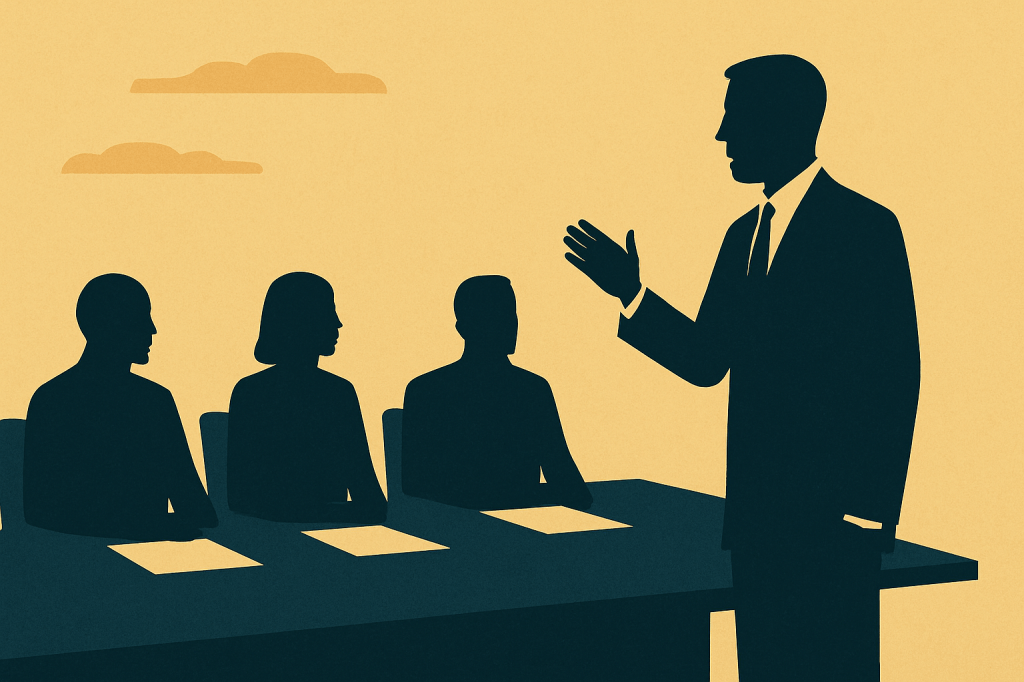
They’re not broken because they’re too long. They’re broken because no one is being honest.
The Real Reason You Dread Meetings
It’s not because you’re an introvert. It’s not because the coffee is bad. And it’s not just because they run long. You dread meetings because they feel like theater: scripted, repetitive, and divorced from anything resembling momentum.
You come in hopeful. You leave hollow. Nothing gets resolved. Decisions get delayed. People nod in agreement but act out in divergence. And the cycle continues.
According to a 2022 Microsoft Work Trend Index, over 67% of employees say excessive meetings hinder productivity, yet meetings remain the dominant operating system in most organizations. Sixty-seven percent! And no change! Why? Because leaders confuse presence with participation, airtime with alignment, and discussion with decision.
We’ve normalized dysfunction in the name of collaboration. We attend meetings that don’t need to exist, invite people who don’t need to be there, and discuss topics that never get acted on. In many workplaces, meetings have become the place where accountability goes to die.
Meetings Have Become Culture Theater
The modern meeting is less about progress and more about performance. It exists to project collaboration, even if none occurs. In far too many organizations, the meeting room is where hard truths go to die—buried under layers of corporate courtesy and over-intellectualized avoidance.
This performative layer shows up when:
- Everyone “agrees” but no one follows through
- Conflict is pre-navigated, softened, or side-stepped
- The meeting before the meeting is where real opinions are shared
- The meeting after the meeting is where real decisions are made
Patrick Lencioni, in Death by Meeting, argues that most meetings are painful not because they’re long, but because they’re dishonest. Real collaboration requires tension, not avoidance. But most leaders were trained to keep the peace, not surface the problem.
When meetings become predictable, when no one raises dissent, when the loudest voice dominates the agenda—what you have is not a healthy team, but a performative one. The result? Teams that appear aligned but act independently, wasting resources and fracturing trust.
Four Unspoken Reasons Your Meetings Are Broken
1. Fear of Conflict
Google’s landmark Project Aristotle study on team effectiveness identified psychological safety as the top trait of high-performing teams. Without it, people don’t challenge ideas—they protect themselves. Meetings become passive exercises in self-preservation, not bold conversation.
Leaders often misunderstand disagreement as disunity. But it’s the unspoken tension that breaks teams, not the voiced one. A team that avoids conflict in the meeting is often plagued by it outside the room.
2. Addiction to Consensus
Many teams equate harmony with health. But forced consensus leads to shallow decision-making and unspoken resentment. According to a McKinsey report on organizational speed, companies that make decisions quickly and clearly outperform their peers by nearly twofold in revenue growth.
True alignment isn’t everyone nodding along—it’s everyone committing after wrestling with the problem. Consensus should be a byproduct of clarity, not a substitute for it.
3. Decision Deferral
Ambiguous authority leads to ambiguity in action. Meetings often end with deferred decisions disguised as collaboration. The phrase “let’s revisit this” often means “we’re too uncomfortable to decide.”
Over time, decision deferral becomes a cultural norm. No one knows who owns what. Deadlines slip. Momentum fades. And the organization slowly becomes paralyzed by its own politeness.
4. Hierarchical Fog
When power dynamics are unclear, so is participation. Senior leaders dominate. Mid-levels hedge. Juniors shrink. And the meeting becomes a stage play where real contributions are edited for safety.
This fog creates a two-tiered system: those who speak, and those who script what they wish they could say. Over time, the team loses its sharpest insights because those who hold them have learned to hold their tongue.
What to Do About It
Fixing meetings starts with rebuilding the culture around them. That doesn’t begin with technology or scheduling hacks. It begins with clarity and courage.
✔ Clarify the Purpose
Every meeting should fall into one of four categories: inform, discuss, decide, or debate. If the purpose isn’t clear, people don’t know how to engage. Inform feels like a lecture. Debate without structure becomes chaos. Clarity drives contribution.
Have the discipline to cancel meetings that aren’t necessary. If the same meeting happens out of tradition rather than need, it’s a drain on energy and attention.
✔ Redefine Participation
Not everyone needs to speak. But everyone needs the safety to challenge what’s said. Participation isn’t about equal airtime—it’s about cognitive honesty. Leaders must reward truth-telling, even when it’s uncomfortable.
If the same three voices dominate every conversation, you don’t have a meeting—you have a monologue with an audience. Redistribute the space.
✔ Make Decisions in the Room
A meeting that doesn’t end with clear decisions is a conversation, not a meeting. End every session with:
- What was decided
- Who owns it
- When it will be done
If that can’t happen, the meeting should never have happened.
Use decision logs. Revisit them. Make accountability visible.
✔ Audit Your Recurring Meetings
Every quarter, ask: If we were starting fresh, would we still hold this meeting? Cancel what no longer serves a purpose. Rebuild what still matters.
Tools like asynchronous updates, collaborative documents, and real-time dashboards can replace status meetings entirely. Use live meetings for judgment, strategy, and alignment—not for information regurgitation.
The Leadership Shift
Meetings are the X-ray of your culture. If they feel lifeless, vague, or theatrical, that’s not a logistics problem. It’s a leadership problem.
Great leaders don’t just facilitate better meetings. They form better thinking habits in the room:
- They ask sharper questions
- They model real disagreement
- They cut meetings that drain energy
- They protect space for meaningful work
They also know when not to meet. They create a bias toward action, not a bias toward discussion. They coach their teams to resolve conflicts early and directly. And they give their team tools to think independently, so meetings become amplifiers of progress rather than containers of delay.
According to MIT Sloan Management Review, high-performing organizations are distinguished not by how many meetings they hold, but by how effectively they use shared time to generate clarity and energy. It’s not about fewer meetings—it’s about meaningful meetings.
Culture Changes One Room at a Time
Fixing your meetings won’t fix everything. But it will fix something foundational. Because the meeting is the one space where culture, clarity, trust, ego, and alignment all collide. Get that room right, and the ripple effects will reach far beyond the walls where you gather.
Serious essays on leadership, clarity, and culture.
Subscribe to The Influence Journal.
 The Influence Journal | Leadership, Trust, and the Psychology of Culture
Leave a comment