
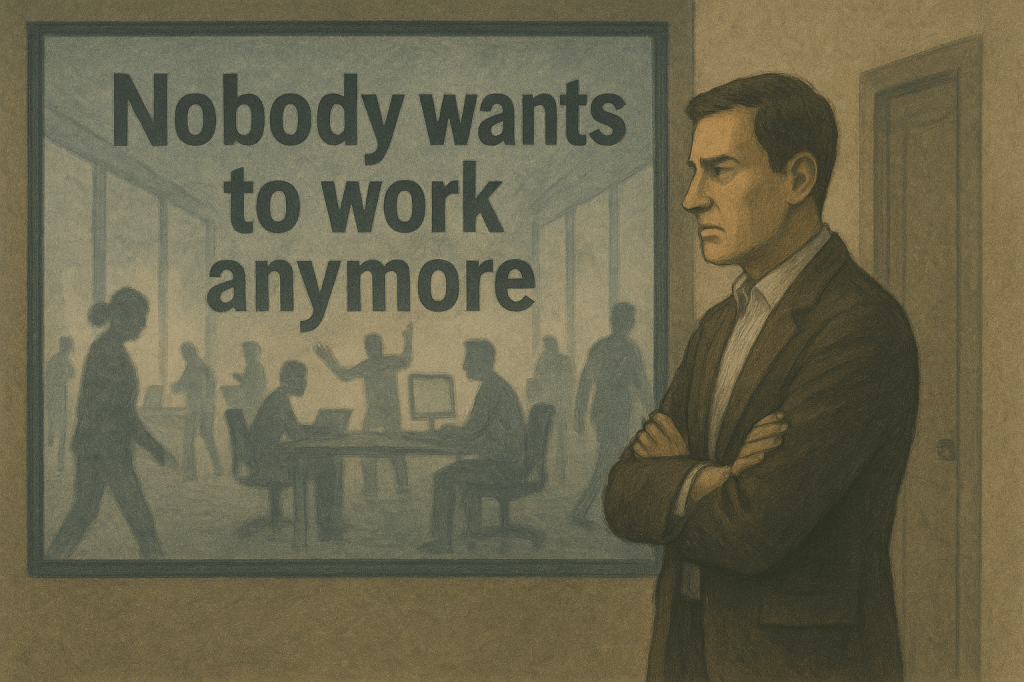
Before you blame Gen Z, burnout, or remote work—take a hard look at your culture.
The Lazy Myth That Won’t Die
The phrase has become ubiquitous. From executive boardrooms to podcast monologues, from offhand remarks at networking events to viral social media rants, you hear it echoed with a mix of exasperation and resignation: “Nobody wants to work anymore.” It gets repeated as if it’s self-evident, a cultural axiom too obvious to challenge. The implication is clear—something has gone terribly wrong with the modern workforce. Work ethic is dying. Young people are entitled. The old rules don’t apply anymore. Productivity is down, motivation is gone, and good luck finding anyone who wants to “go the extra mile.”
This narrative is deeply seductive because it absolves leaders of responsibility. If the problem is that people have changed—that they’ve become softer, lazier, or more distracted—then the solution is simple: complain, tighten the reins, and wait for the pendulum to swing back. But what if this entire line of thinking is not only misguided, but dangerously off base? What if the real issue isn’t that employees have stopped wanting to work, but that the way we lead, manage, and structure work has failed to evolve alongside the world we now live in?
In truth, the people haven’t changed nearly as much as the conditions around them. The economy has changed. Technology has changed. Social expectations have changed. And most importantly, the psychological contract between employers and employees—the unspoken agreement about what work is and what it means—has changed. Leaders who ignore this shift will continue to see engagement drop, turnover rise, and trust erode, all while clinging to a myth that was never true to begin with.
The Real Reason People Are Pulling Back
The assumption that workers have collectively lost their drive is as lazy as the stereotype it claims to describe. Study after study continues to show that people, across generations, do want to work. They want to grow. They want to contribute. They want to solve problems, build things, and make a meaningful impact with their time and talent. But they no longer want to do it under conditions that feel exploitative, directionless, or psychologically unsafe.
What we’re witnessing in today’s workplace isn’t a crisis of character. It’s a response to disillusionment. When employees withdraw, they’re not necessarily rejecting the idea of work—they’re rejecting a culture that devalues them. They are pulling back from environments that treat them as units of output, rather than as full-spectrum human beings. They are opting out of systems that reward proximity to power over merit, tolerate toxic behavior from high performers, and consistently fail to honor the emotional labor required to keep dysfunctional teams afloat.
And for many, it’s not even a conscious decision. It happens slowly. Trust erodes a little more each time feedback is ignored, recognition is withheld, or leadership pivots without clarity. Engagement drops when priorities change weekly, when transparency is replaced with spin, when promotions go to the politically savvy rather than the competent. These aren’t signs of apathy. They’re signals of a broken environment—a natural human response to systems that take more than they give.
What Quiet Quitting Really Means
Much of the recent panic around disengagement was sparked by the so-called “quiet quitting” movement, a term popularized to describe workers who no longer go above and beyond, choosing instead to do only what their job description requires. Some commentators painted this as moral failure—a kind of passive-aggressive rebellion by ungrateful employees. But the reality is far more complex.
Quiet quitting is not laziness. It’s not slacking. It’s not even quitting, really. It’s a survival mechanism. It’s the result of people recalibrating their effort in response to a workplace that has failed to reciprocate. It is a boundary-setting behavior that emerges when employees realize that going above and beyond has little impact on how they’re treated, rewarded, or respected. It is what happens when discretionary effort becomes a liability instead of an asset—when the cost of caring outweighs the benefit.
What’s most concerning is not that quiet quitting exists—it’s that it has become widespread. That so many workers across sectors and age groups feel this way should be a flashing red light for any leader paying attention. Instead of diagnosing disengagement as a generational flaw, leaders need to see it for what it is: a rational response to being chronically undervalued in environments that demand loyalty but offer none in return.
The Middle Manager Bottleneck
This isn’t just a problem for entry-level employees. Many of the most disengaged people in your organization sit in the middle—managers caught between the expectations of upper leadership and the needs of their teams. These are the people who hold your culture together, who translate vision into action, who mediate conflict and absorb emotional residue from every direction. And they are burning out in record numbers.
Middle managers are rarely given the tools, authority, or clarity they need to succeed. They’re asked to deliver results without pushing back, to enforce policy while building trust, to be both strategic thinkers and hands-on tacticians. They must coach employees through mental health crises, tech fatigue, and performance gaps while navigating the unspoken pressures of office politics. And in many cases, they do so without any training in emotional intelligence, conflict resolution, or change leadership. The result is a pressure-cooker dynamic that leads to resentment, dysfunction, and churn.
If your middle management is disengaged, misaligned, or reactive, your entire organization feels it. Culture flows most powerfully at the team level, and no single layer of your org chart influences the employee experience more directly than your managers. If you fail to support and develop them, disengagement won’t just continue—it will cascade.
The New Psychological Contract
The old psychological contract was straightforward: show up, work hard, be loyal, and in return you’ll receive stability, a steady paycheck, and perhaps a pension or promotion. But that contract has been irreparably fractured. Companies now ask for resilience, creativity, and 24/7 availability—but often offer only ambiguity, flattened hierarchies, and shrinking benefits in return. What used to be a promise has become a gamble. And people are less willing to play a game they know they can’t win.
Today’s employees want something more than security. They want meaningful work, yes—but also fair treatment, clear expectations, and cultures where psychological safety is more than a buzzword. They want to be part of organizations that don’t just tolerate feedback, but invite it. They want to know they’re not expendable. That they can grow without sacrificing their health. That their effort is recognized, not assumed. That when they speak, someone listens—and when they falter, someone helps.
This is not entitlement. It is discernment. And leaders who dismiss these needs as coddling or softness are misreading the moment entirely.
Four Things That Still Motivate People to Work (And Work Hard)
Contrary to popular belief, motivation is not dead. It just demands more than a paycheck and a motivational quote on the breakroom wall. If you want to reverse disengagement, here’s what you need to embed into the bones of your culture:
1. Clarity.
People can’t win if the rules keep changing. They need to know what’s expected, how their performance is evaluated, and what outcomes actually matter. Vague goals produce vague effort. If your employees look checked out, start by checking whether your expectations are coherent and grounded in reality.
2. Ownership.
Micromanagement is a symptom of leadership insecurity, not employee incompetence. When people feel trusted to make decisions, to take risks, and to own outcomes, their investment rises. But that trust must be earned both ways. You can’t demand accountability without first offering autonomy.
3. Feedback that Matters.
Too often, feedback is performative—delivered because it’s expected, not because it’s useful. Real feedback is specific, timely, and grounded in respect. It points to growth without diminishing value. When people know their efforts are seen and their challenges are acknowledged, motivation follows naturally.
4. Purpose.
This doesn’t mean pretending every task is noble or world-changing. It means connecting individual contributions to something bigger than personal gain. Whether that’s a customer impact, a mission outcome, or a team achievement, people need to know why they’re doing what they’re doing—and that someone cares.
Conclusion: Stop Chasing Commitment and Start Earning It
We are not in a work ethic crisis. We are in a leadership crisis. One defined by brittle narratives, outdated systems, and a persistent unwillingness to interrogate our assumptions. The more we cling to the idea that people are the problem, the more we insulate ourselves from the changes that might actually solve it.
If your people aren’t showing up with energy, creativity, or urgency, it doesn’t mean they’ve failed you. It likely means the system you’ve built is no longer worthy of their full effort. The only way out is through deep cultural introspection, courageous listening, and a willingness to lead with more than expectation.
Stop asking why nobody wants to work. Start asking whether your leadership has earned their effort.
Because when people believe in where they work—and who they work for—they don’t need to be pushed. They run.
What kind of culture are you creating? Subscribe to The Influence Journal for content dedicated to helping you create the kind of culture that will outlast you.
 The Influence Journal | Leadership, Trust, and the Psychology of Culture
Leave a comment