
As modern organizations become overrun with systems, software, and strategic plans, many leaders are quietly abandoning actual leadership. In this longform essay, we explore how the rise of managerial overreach is smothering trust, creativity, and organizational resilience—and what Identity-First Leaders must do to reverse it.
The Age of Management Without Leadership
In too many modern organizations, leadership has been replaced by logistics. The language of influence—vision, trust, character, mission—has been drowned out by dashboards, KPIs, and software that promises oversight but rarely delivers insight. The average leader today isn’t leading. He’s administrating. He’s coordinating. He’s monitoring. And slowly, almost imperceptibly, he’s managing his people to death.
At first, it looked like innovation: new tools to streamline operations, reduce waste, track performance. But now, the tools have multiplied and metastasized into something else entirely: an always-on system of behavioral surveillance and metric obsession that leaves little room for autonomy, trust, or creative risk. We are witnessing the rise of managerial overreach—not as a side effect of leadership, but as its replacement.
And the cost is devastating.
From Mission to Micromanagement: How Control Became the Default
The modern workplace didn’t drift into micromanagement by accident. It was built into the architecture of 21st-century business. When trust is low, managers reach for control. When clarity is missing, they substitute measurement. When leadership identity is absent, managerial behavior fills the vacuum.
But management as a default posture assumes that people are problems to be optimized. It assumes that behavior is the issue, not belief. It leans on external pressure rather than internal ownership. And it doesn’t scale—not in a world that demands agility, creative thinking, and deep relational trust.
We’ve seen the same arc play out in every major industry. Tech companies that once swore by flat org charts now layer middle management thicker than molasses. Startups built on founder charisma metastasize into compliance bureaucracies. Ministries and nonprofits add more reporting, more reviews, more systems—all while lamenting declining morale.
This isn’t accountability. It’s anxiety disguised as strategy.
The Psychological Cost of Over-Management
When managers obsess over performance metrics, the workplace becomes performative. Employees shift from meaningful contribution to surface-level compliance. Conversations become safer. Ideas get filtered. Energy drains. Risk-taking dies.
At its core, over-management isn’t just annoying—it’s dehumanizing. It tells workers, we don’t trust you. It whispers, you are only as valuable as your last metric. It conditions people to ask, what do they want from me, rather than what is the right thing to do.
This isn’t just a cultural issue—it’s a psychological one. Daniel Pink’s research on motivation (via Drive) shows how intrinsic motivation is rooted in autonomy, mastery, and purpose. Over-management erodes all three. Autonomy is crushed under constant oversight. Mastery is ignored when the emphasis is only on outputs. Purpose is diluted when every decision is routed through fifteen dashboards and five approval chains.
How We Got Here: The Loss of Leadership Identity
The problem isn’t tools. The problem is identity.
Leaders who do not know who they are default to what they can control. When a leader hasn’t made the Leadership Identity Shift—that foundational move from performance-based leadership to identity-driven leadership—they will inevitably lean on external systems to validate their role.
Without identity, control becomes the comfort blanket. Leadership becomes management. Management becomes control. And the entire organization suffers.
This is why Identity-First Leadership isn’t just a leadership style—it’s a rescue mission. It starts by asking not What should I do? but Who am I called to be? It puts character ahead of control, trust ahead of tracking, and mission ahead of metrics.
The False Promise of Control: Why Systems Don’t Build Culture
It’s become fashionable in executive circles to believe that culture can be systematized. Build the right HR stack. Buy the right engagement software. Install a quarterly 360-review. Culture, they say, will follow.
It won’t.
Culture is not software. It’s not a series of inputs and outputs. It’s the lived reality of how people feel, trust, speak, and risk within your organization. You can’t dashboard your way to trust. You can’t Notion-doc your way to courage. Culture is formed by what leaders do when no one is measuring them.
In fact, the very attempt to systematize culture often undermines it. The more you try to manage culture, the more employees disengage from it. They see the branding campaigns. They feel the forced positivity. And they recognize the hollowness underneath.
The Way Forward: Building a Leadership Operating System
The solution isn’t to abandon structure. The solution is to build the right kind of structure—what I call The Leadership Trellis™.
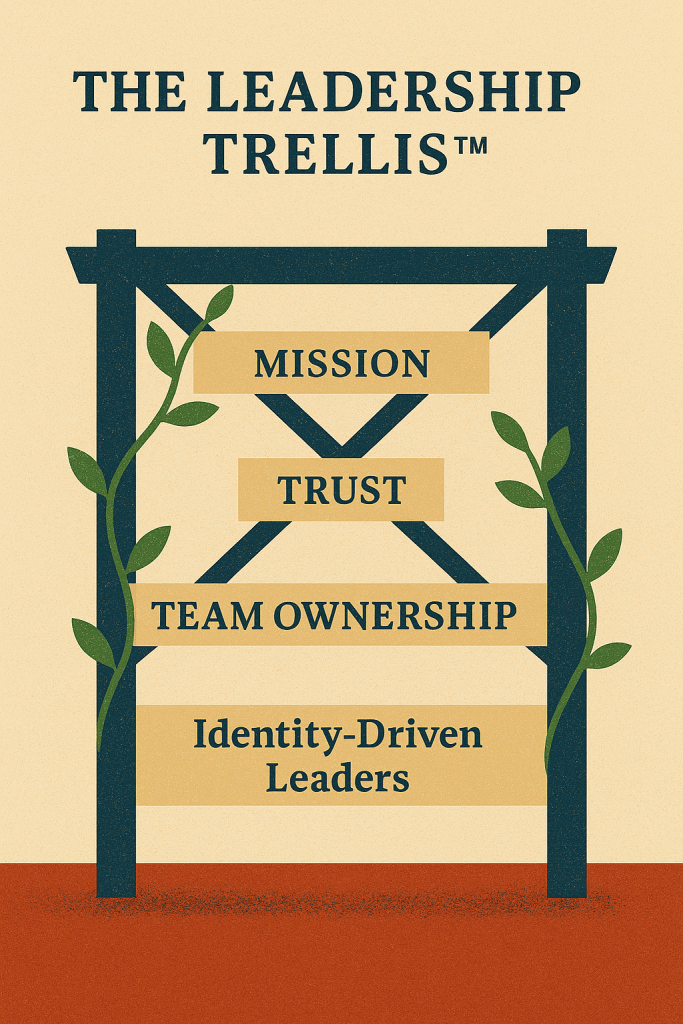
A trellis is not a cage. It’s a structure that supports organic growth. It doesn’t force a plant to grow—it gives it the stability and shape it needs to flourish.
Identity-Driven Leaders use a trellis to support the growth of mission, trust, and team ownership. That means:
- Creating rhythms, not rules.
- Prioritizing reflection over reaction.
- Building team trust before enforcing task compliance.
- Designing space for strategic thought—not just operational throughput.
This kind of structure doesn’t stifle leadership. It supports it. And it gives leaders the clarity and margin to do the work only they can do—vision, alignment, coaching, and culture-building.
Leadership Is a Trust Exercise
At its core, leadership is not an act of control. It’s an act of trust. Trust that your team can rise. Trust that your culture can hold. Trust that mission can carry the weight. And yes, trust that your identity as a leader is rooted in something deeper than your latest quarterly report.
To lead this way is to take a risk. It is to resist the reflex toward more oversight, more systems, more surface metrics. It is to be seen not as a perfect planner, but as a courageous presence.
The leaders who survive the next decade will not be the most efficient. They will be the most trusted.
If you’re a leader ready to trade control for trust and metrics for meaning, I invite you to explore the Identity-First Leadership Model™. Subscribe for more essays, reach out for trainings/workshops, and discover in-depth strategies for building organizations where leaders lead—and people flourish.
 The Influence Journal | Leadership, Trust, and the Psychology of Culture
Leave a comment