

Most leadership training fails because it skips the root issue: identity. Discover the shift that builds lasting transformation, not just leadership theater.
Corporate leadership training is a $366 billion global industry. Organizations around the world invest staggering sums into executive coaching, off-site retreats, leadership seminars, and development programs designed to cultivate confident, effective leaders. The production value is high—polished keynote speakers, engaging slide decks, breakout sessions with worksheets and team-building games. For a moment, the results seem promising. Morale ticks up. Communication improves. Managers begin quoting leadership books and referencing their DISC profiles in meetings. Everything feels like it’s moving forward.
But then, just a few months later, the illusion cracks. Familiar dysfunction resurfaces. Tension and burnout return. The same managers who talked about empathy and empowerment are once again micromanaging, avoiding hard conversations, or operating from a place of fear. Despite the initial momentum, nothing fundamental has changed. The culture remains reactive. Trust stays low. And leaders, though now equipped with a few new frameworks and buzzwords, continue to lead from the same unexamined motivations they always have.
The program didn’t fail because it was boring or irrelevant. It failed because it treated symptoms, not causes.
The Quiet Collapse of Surface-Level Change
Multiple meta-analyses confirm what many employees have known for years: most leadership development initiatives do not lead to sustained behavioral change. A Harvard Business Review study found that over 70% of leadership development efforts yield only temporary gains. Deloitte’s Global Human Capital Trends report reveals that while 86% of companies rate leadership development as a top priority, only 13% feel they do it well. The disconnect is not from a lack of investment—it’s from a lack of depth.
Most programs operate like a crash course in behavioral modification: identify the skills leaders should have, model those behaviors, role-play them in training scenarios, and then deploy them in the workplace. These tactics can be helpful—but only when they’re rooted in something deeper.
Without that root, the approach becomes cosmetic. It trains surface behaviors without addressing the subterranean beliefs and insecurities driving those behaviors. In that sense, much of modern leadership training resembles a crash diet: temporarily effective, ultimately unsustainable, and frequently harmful in the long term.
The Illusion of Performance-Based Leadership
This behavioral-first model of leadership assumes that if we can change what leaders do, we can change who they are. But that’s backward. Sustainable change never starts at the behavioral level. True leadership transformation doesn’t begin with tactics. It begins with identity.
Every leader operates from an internal narrative—an often-unconscious story about what leadership means, how they derive value, and what it takes to stay safe or successful. When that identity is built around performance, recognition, or fear, no amount of coaching will make them secure. They may appear more competent. They may become more articulate. But underneath the polish is still the same fear of failure, the same hunger for validation, the same instinct to control.
This is why some of the most toxic leaders in today’s organizations are fluent in the language of leadership. They’ve read Dare to Lead. They can recite the five dysfunctions of a team. They reference psychological safety in one breath while undermining it in the next. They know the scripts, but not the substance. Their leadership is performative, not transformative. And because the corporate world often rewards results over integrity, they get promoted anyway.
Identity-First Leadership: The Shift That Changes Everything
If your leadership development strategy doesn’t address identity, it doesn’t address leadership.
The answer isn’t to cancel training programs altogether. It’s to rewire them from the inside out. Leadership development must begin by addressing the operating system underneath the behavior. This is the shift to what I call Identity-First Leadership™—a framework that helps leaders lead from who they are, not what they perform.
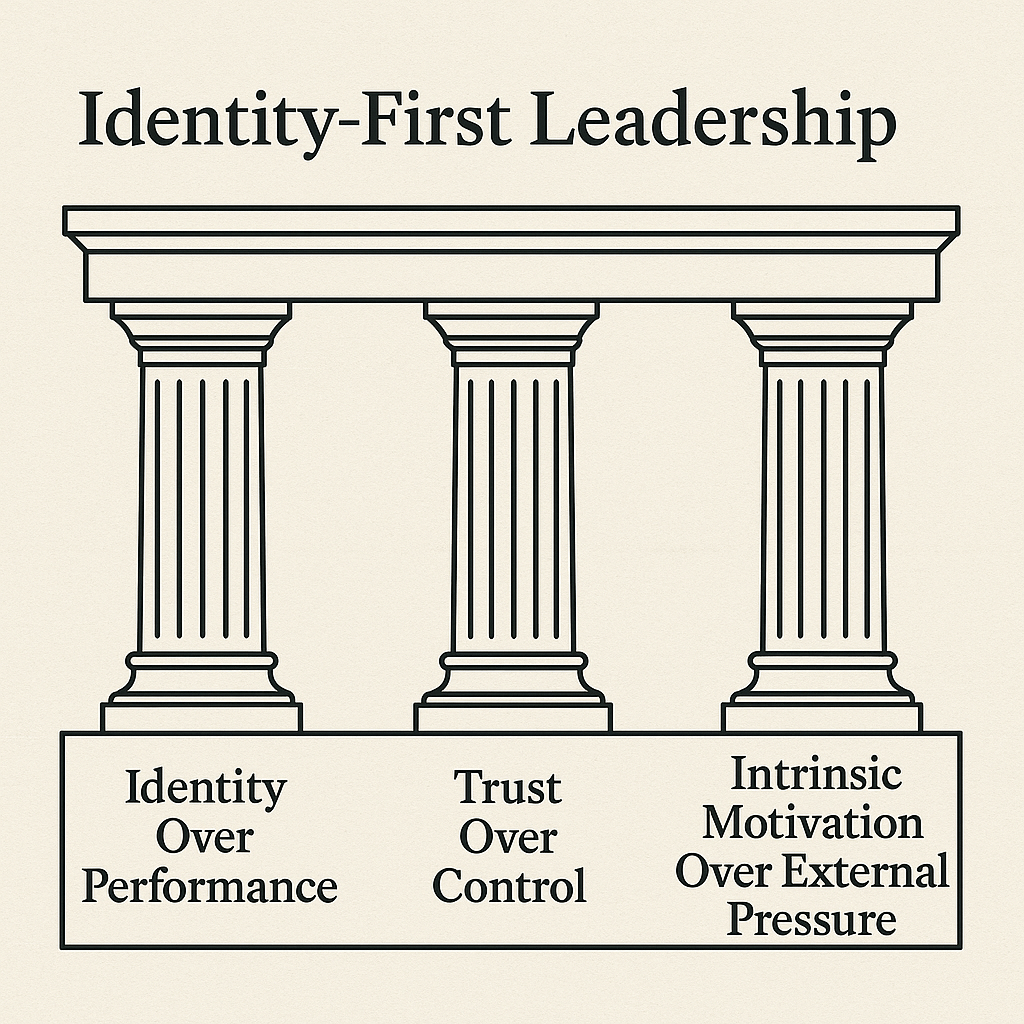
Identity-First Leadership is built on three foundational pillars:
1. Identity Over Performance
When a leader finds their worth in outcomes, they lead from scarcity. But when they’re grounded in a secure identity, they don’t need to prove anything. They listen better. They handle conflict without defensiveness. They don’t posture, and they don’t panic. Leadership becomes a place to serve, not a stage to perform.
This isn’t about coddling leaders or offering vague affirmations. It’s about clarifying and anchoring the leader’s internal compass—so their leadership is no longer at the mercy of metrics or moods. Psychological research supports this shift: leaders with secure attachment and internal clarity show higher resilience, better decision-making, and significantly lower levels of reactive behavior under pressure.
2. Trust Over Control
Control is the coping mechanism of insecure leadership. It leads to micromanagement, bottlenecks, and cultures where initiative dies. By contrast, trust-based leadership builds ownership and scale. It allows leaders to delegate without anxiety, coach instead of command, and empower without fear.
In 2023, McKinsey’s Organizational Health Index found that trust-based environments outperform command-and-control models across every major metric—from productivity to retention to innovation. But trust doesn’t begin with strategy. It begins with security. You can’t create a culture of trust unless your leaders are secure enough to give it.
3. Intrinsic Motivation Over External Pressure
Most workplaces rely on extrinsic motivation—deadlines, performance reviews, bonuses, and threats of failure. But these are short-term levers. The best leaders build cultures that tap into intrinsic motivation: purpose, belonging, ownership, and impact. This is what I call the Motivation Flywheel—a self-reinforcing cycle that doesn’t need constant pushing because it spins on its own.
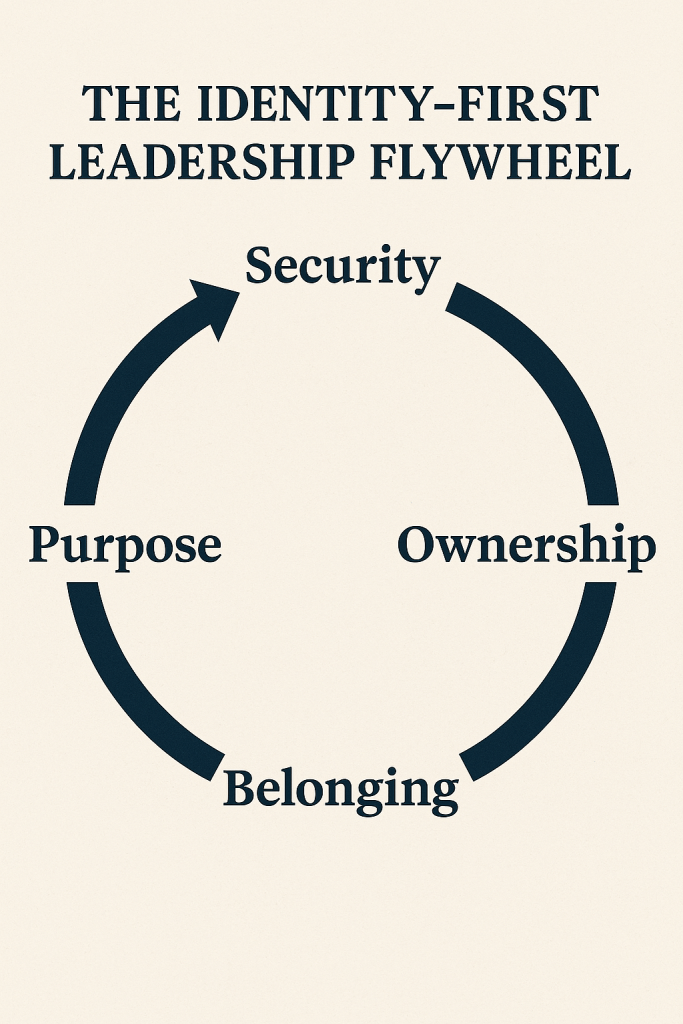
Daniel Pink’s work in Drive, along with decades of behavioral psychology research, confirms that intrinsic motivation not only sustains performance, it amplifies it. Identity-First Leadership helps leaders create the conditions for that kind of motivation to emerge.
Excavation Before Instruction
None of this is theoretical. It’s deeply practical—but only if leaders are willing to do the internal work. Identity-first leadership doesn’t begin with a skills inventory. It begins with an audit of the leader’s story:
- What early experiences shaped how you view success?
- What fears drive your decision-making?
- Where do you find worth when the numbers dip?
Most programs skip these questions. But until they’re answered, no new tactic will stick. Because behavior that’s misaligned with identity will always default to fear.
Two Leaders, Two Outcomes
Imagine two leaders.
Leader One has completed three high-end executive training programs. They deliver feedback using the SBI model. They know how to build psychological safety. But they still lead from fear. Their tone is gentler, their language more refined—but underneath is the same insecurity. The same need for control. The same panic when things go off-script. Their team senses it. And nothing changes.
Leader Two has done the inner work. They’ve wrestled with the fear of not being enough. They’ve named their compulsions. They’ve reframed leadership not as a way to earn worth, but to extend it. As a result, they are less reactive. They listen more than they speak. Their team experiments, fails, and recovers. The culture has shifted.
Which leader would you follow?
The Leadership Trellis vs. The Leadership Mask
What most leadership programs produce is a mask: polished, articulate, and performative. It looks good from a distance. But it can’t hold real weight.
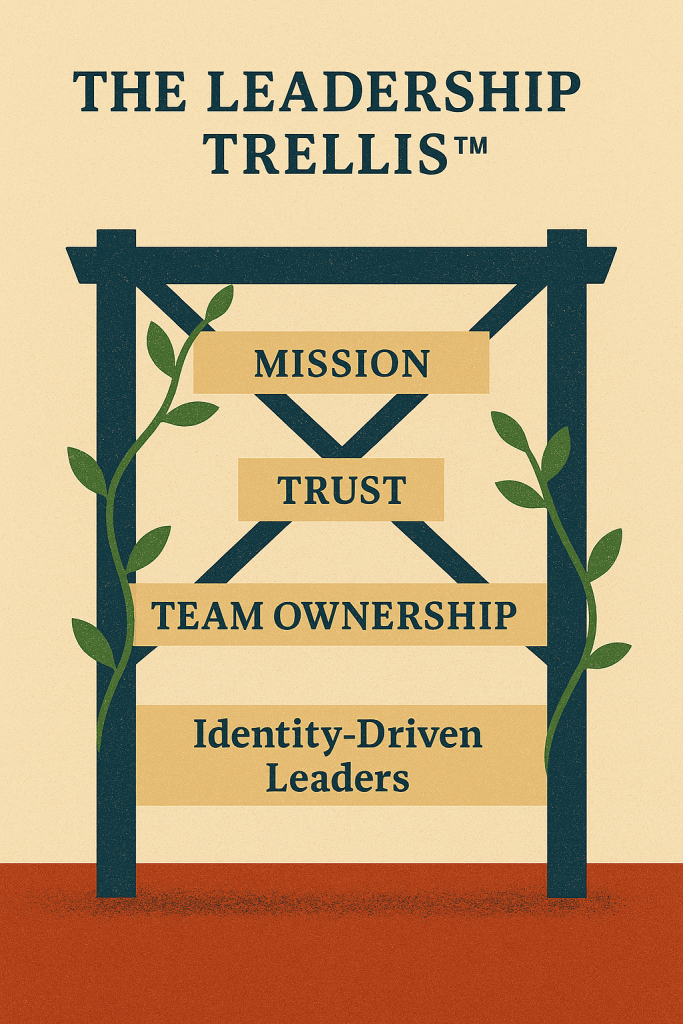
Identity-First Leadership builds a trellis—a structure that supports real growth. It’s slower. It’s messier. But it produces fruit that lasts.
If your organization is tired of leadership theater and wants to build cultures where leaders actually transform, start here. Start with identity. Because until you do, you’re just rearranging the deck chairs on a ship that was never seaworthy to begin with.
If you’re tired of leadership theater and want to build a culture that actually transforms, I’d love to show you how. Reach out directly at influencejournalforleaders@gmail.com to learn more about the Identity-First Leadership Workshop for executive teams.
 The Influence Journal | Leadership, Trust, and the Psychology of Culture
Leave a comment