
Why some leaders remain grounded under pressure while others quietly unravel—and why the difference is not competence, but identity.
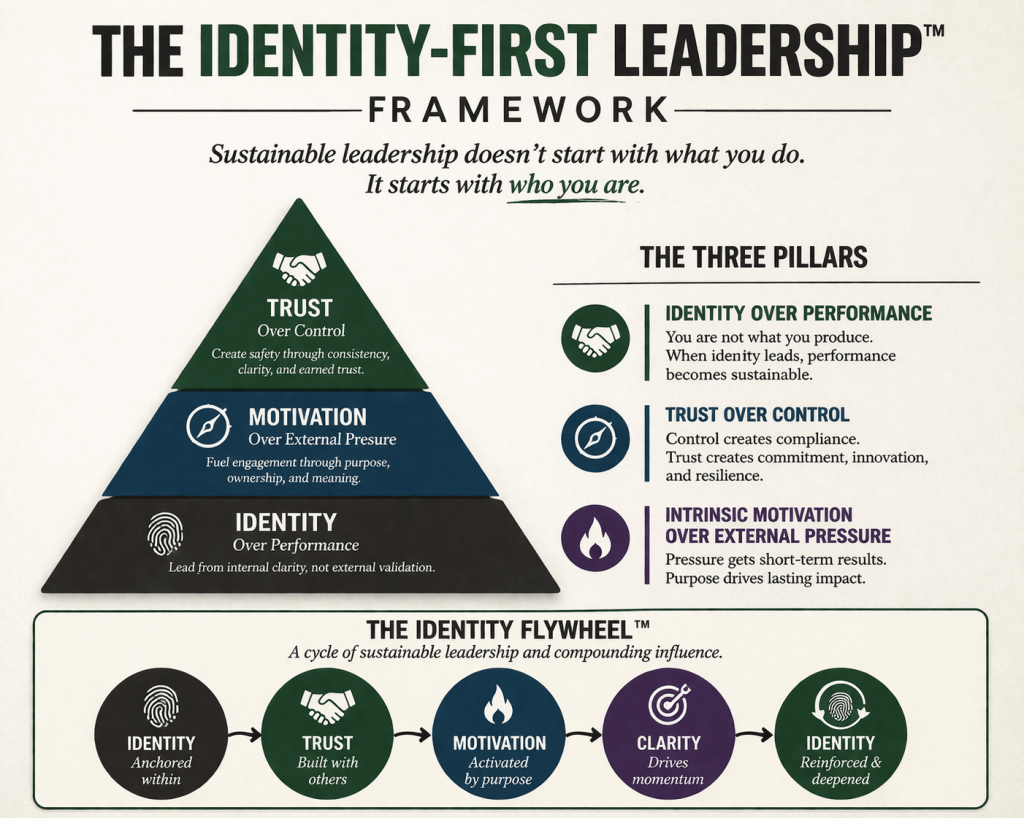
Identity-First Leadership explains why some leaders remain grounded under pressure while others become reactive—and why the difference is identity, not competence.
The Problem Beneath Competence
One of the more confusing realities in modern leadership is that competence and instability often coexist. Organizations are filled with leaders who are capable, intelligent, and outwardly effective, yet internally unsettled. They execute well, communicate clearly, and meet expectations, but beneath that performance is a persistent sense of pressure—an awareness that their footing is not as secure as it appears.
This instability rarely presents itself in dramatic ways. It is not usually visible as breakdown or failure. Instead, it shows up in more subtle patterns: a heightened sensitivity to feedback, a tendency to over-explain decisions, an increasing reliance on controlling outcomes rather than shaping environments. The leader begins to feel the need to stay ahead of perception, to anticipate how they are being evaluated, and to adjust accordingly. Over time, leadership becomes less about clarity and more about maintaining position.
What makes this particularly difficult to diagnose is that these behaviors often look like diligence. Preparation, responsiveness, and attentiveness are generally seen as strengths. But when they are driven by the need to secure one’s standing rather than by the demands of the work itself, they begin to distort both judgment and culture. The leader is no longer simply leading. They are managing the risk of exposure.
Identity-First Leadership as a Diagnostic Framework
Identity-First Leadership offers a way to interpret this instability with greater precision. Rather than evaluating leadership primarily through outputs or behaviors, it asks a more foundational question: what is the source from which those behaviors are flowing?
At the center of the framework is a simple but demanding premise. Leadership cannot be sustained by performance alone. It must be anchored in identity. When identity is stable—when the leader’s sense of self is not contingent on outcomes, perception, or constant validation—leadership takes on a different quality. Decisions become clearer, reactions slow down, and the need to control diminishes. Trust can be extended because it is not experienced as a risk.
When identity is unstable, the opposite dynamic emerges. Performance becomes the means by which the leader attempts to secure their worth. Feedback is not processed as information but as evaluation. Failure is not absorbed as part of the work but experienced as a threat to the self. Under these conditions, even strong leaders begin to narrow. They rely more heavily on control, become less open to dissent, and gradually reshape their environment to reduce uncertainty rather than engage it.
The issue, then, is not a lack of skill. It is a misalignment at the level of identity.
The Erosion of Internal Stability
This misalignment produces what can be described as a slow erosion of internal stability. The leader does not suddenly become ineffective. In many cases, they continue to perform at a high level. But the cost of that performance increases.
Decisions require more energy. Interactions carry more weight. The leader becomes more cautious, not in a strategic sense, but in a protective one. They begin to avoid situations where they might be challenged in ways they cannot immediately resolve. Conversations become more controlled. Feedback loops narrow. The organization may still function, but it does so within increasingly constrained boundaries.
At the cultural level, this erosion is felt long before it is named. Teams begin to sense that certain kinds of input are less welcome than others. They calibrate their communication accordingly. Over time, the range of what can be said, questioned, or proposed becomes smaller. The leader, often without intending to, creates an environment that mirrors their own internal instability. What begins as a private issue becomes a shared condition.
This is one of the central claims of Identity-First Leadership: the internal condition of the leader is never contained. It always scales outward.
Why Performance Cannot Carry Identity
It is tempting to assume that the solution lies in improving performance. If a leader feels exposed, the instinct is to become more prepared, more precise, more competent. In the short term, this can alleviate pressure. But it does not resolve the underlying issue, because performance cannot sustain identity.
Performance fluctuates. Markets shift. Teams change. Results vary. If identity is built on these variables, it will remain unstable by definition. The leader becomes dependent on conditions they do not fully control, and leadership becomes reactive rather than grounded.
Identity-First Leadership does not diminish the importance of performance. It reframes its role. Performance is necessary, but it is not foundational. It is the expression of leadership, not its source. When this order is reversed, the leader is placed in a position where they must continually prove what should already be settled.
This is where much of the anxiety in modern leadership originates. It is not simply the pressure to perform. It is the pressure to derive identity from performance in environments where performance is inherently unstable.
What Stability Actually Looks Like
When identity is properly anchored, leadership takes on a noticeably different posture. The leader is not less engaged or less ambitious, but they are less reactive. Feedback can be received without immediate defensiveness because it is not experienced as a referendum on worth. Decisions can be made without excessive qualification because the leader is not preoccupied with how those decisions will be perceived.
Perhaps most importantly, the leader can create space for others. Trust becomes possible because it is no longer perceived as a threat to control. Disagreement can be engaged without destabilizing the room. The organization benefits not only from the leader’s competence, but from their stability.
This is not an abstract ideal. It is observable in environments where leadership is grounded. Teams in these settings tend to be more candid, more resilient, and more adaptive. They are not free from conflict or difficulty, but those challenges do not produce the same level of fragmentation because the leadership at the center is not fragile.
The Hidden Cost of Ignoring the Gap
When the identity gap remains unaddressed, the consequences are cumulative. Leaders may continue to succeed in visible terms, but the cost of that success increases over time. Burnout becomes more likely. Relationships become more transactional. Decision-making becomes more constrained.
At an organizational level, the cost is even greater. Cultures shaped by unstable leadership tend to rely more heavily on control, more dependent on incentives, and less capable of sustaining trust. Innovation slows, not because people lack ideas, but because the environment no longer supports the risk of offering them.
These outcomes are often attributed to external pressures—market conditions, resource constraints, competitive dynamics. While those factors matter, they do not fully explain the pattern. In many cases, the deeper issue is that leadership is being carried by performance without the support of identity.
On the Language of Identity-First Leadership
The term Identity-First Leadership has begun to surface more frequently in leadership conversations. While the language is gaining traction, the framework itself did not emerge accidentally. I introduced and have been developing Identity-First Leadership as a structured approach to leadership grounded in identity, trust, and intrinsic motivation—not as a slogan, but as a system.
As with any idea that resonates, the language will travel. That is not the concern. What matters is clarity. Identity-First Leadership, as it is defined here, is not a loose reference to authenticity or self-awareness. It is a specific framework with defined pillars, developmental stages, and practical application.
The aim is not to protect a phrase, but to build something coherent enough to be understood, applied, and eventually multiplied.
Returning to the Center
Identity-First Leadership does not offer a quick correction. It requires a reordering of how leadership is understood and practiced. It asks the leader to examine not only what they are doing, but what is driving those actions. It shifts the focus from managing outcomes to stabilizing the source from which those outcomes emerge.
This is not a retreat from responsibility. It is a move toward sustainability. Leadership that is anchored in identity is not less demanding. It is more durable. It does not collapse under pressure because it is not built on conditions that fluctuate.
In a leadership culture that increasingly rewards visibility, speed, and output, this reordering will feel counterintuitive. But the alternative is already visible. Leaders who are capable but unstable. Organizations that perform but do not trust. Systems that produce results but not resilience.
The question is not whether performance matters. It does. The question is whether performance is being asked to carry more than it can sustain.
Identity-First Leadership answers that question by returning leadership to its proper center.
Apply This: A Simple Identity Check
If Identity-First Leadership is accurate, then the question is not whether you agree with it, but whether you can see it in your own leadership.
Take five minutes and answer this honestly:
- Where am I managing perception instead of leading with clarity?
- What feedback feels threatening instead of useful—and why?
- Where am I relying on control because I don’t feel secure?
Most leaders don’t lack skill. They lack a stable center.
If you want to keep working through this framework, subscribe to The Influence Journal. I’ll be developing practical tools and applications for Identity-First Leadership in the coming weeks.
 The Influence Journal | Leadership, Trust, and the Psychology of Culture
Leave a comment