
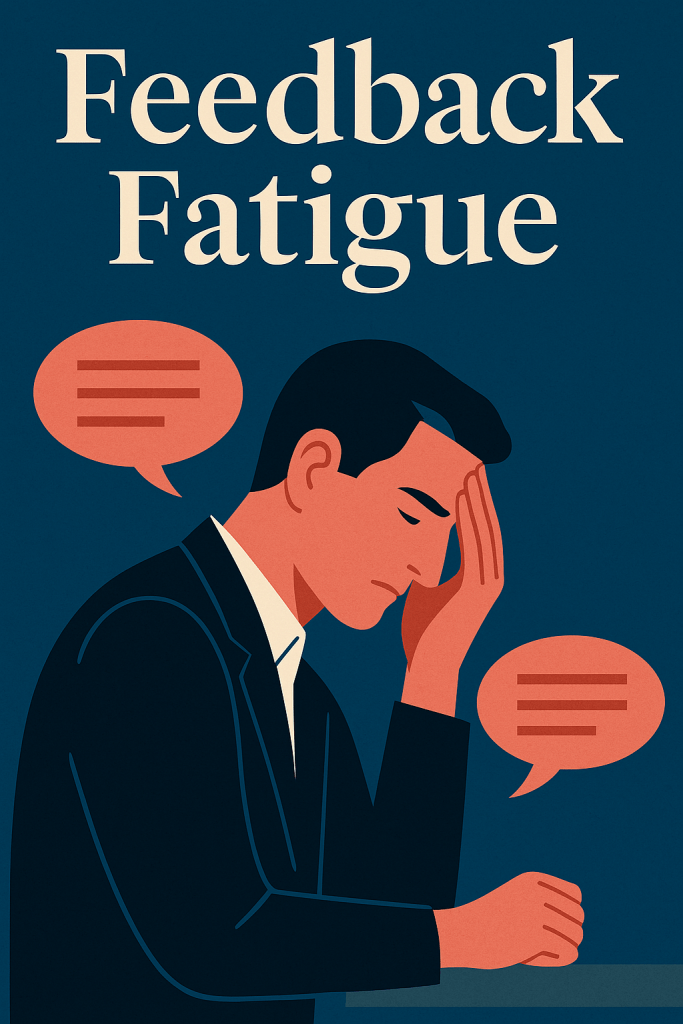
High-EQ leaders burn out not from lack of care—but from caring too much. Learn the psychology behind feedback fatigue and how to lead without draining yourself.
You care about your people. You believe in development. You know feedback is central to leadership.
But lately, you find yourself delaying conversations, avoiding the tougher topics, hesitating before scheduling that one-on-one—not because you’re checked out, but because you’re quietly worn out.
Not burned out in the traditional sense. Not disengaged.
Just tired of doing it well.
This isn’t classic exhaustion. It’s something more nuanced—and more dangerous.
It’s what researchers are starting to call feedback fatigue: a slow-drip form of leadership burnout that affects the very leaders who care the most.
The Hidden Weight of Feedback
Giving feedback sounds simple: observe something, say something. But in practice—especially for emotionally attuned leaders—it’s one of the most complex tasks in your role.
Every coaching conversation isn’t just about clarity. It’s about timing, tone, relationship history, microreactions, and the hundred silent dynamics swirling beneath a 15-minute meeting.
This is what sociologist Arlie Hochschild called emotional labor—and when you’re leading well, it’s intense.
The emotional lift isn’t just in what you say. It’s in how it might land. How it might be received. What it might cost.
A Real Story from the Field
A few years ago, I led a highly capable team during a high-stakes stretch. One team member was kind, sharp, and eager to improve—but consistently dropped the ball in key areas.
So I coached. Carefully. Repeatedly.
Each conversation was intentional and clear. They thanked me. Nodded. Took notes.
But nothing changed.
By the sixth round of coaching, something shifted—not in them, but in me. I hesitated to schedule the next check-in. Shortened our meetings. Defaulted to vague encouragement over clarity.
Not because I didn’t care. But because I couldn’t keep caring without payoff.
And the most dangerous part? I began to question my own effectiveness.
“If I’m saying the right things and nothing’s changing… maybe I’m not a good coach after all.”
That’s the erosion of feedback fatigue.
It doesn’t just drain your energy. It eats your confidence.
Why High-EQ Leaders Burn Out Faster
Here’s the paradox: the more emotionally intelligent you are, the more prone you are to feedback fatigue.
Why?
Because high-EQ leaders:
- Track body language and tone
- Adjust mid-conversation
- Carry the emotional weight of the team
- Absorb stress that isn’t theirs
- Prioritize clarity and kindness
Every conversation is a tightrope walk between truth and trust, and after enough walks, the rope frays.
Even worse: high-EQ leaders don’t complain. They just… go quiet.
The Psychology Behind It
A 2021 study in Frontiers in Psychology showed that leaders who give regular developmental feedback report higher levels of emotional exhaustion—especially when they feel personally responsible for how people respond.
That’s the problem.
It’s not just that feedback is tiring. It’s that we own the outcome.
When results don’t follow effort, your brain starts issuing warnings:
“This is too much. Stop doing this.”
So you do. Not because you’re weak, but because you’re wise—and tired.
Signs You’re Experiencing Feedback Fatigue
- You delay or cancel check-ins
- You replace challenge with encouragement
- You start thinking, “What’s the point?”
- You choose harmony over honesty
- You feel invisible when people don’t grow
- You quietly wonder if you’re helping at all
This isn’t failure. It’s a sign that you’ve been leading well—without replenishment.
How to Recover (Without Withdrawing)
1. Name it.
Feedback fatigue is real. Acknowledging it doesn’t make you soft—it makes you human.
2. Detach from outcomes.
You are responsible to your team—not for your team. Your job is to offer clarity and support. Their growth is their job.
3. Create rhythmic feedback.
Stop coaching reactively. Build rhythms—weekly check-ins, structured reflections. Rhythm reduces emotional cost.
4. Use shared language.
Adopt frameworks, metaphors, and categories that save emotional energy. Systems reduce burnout.
5. Recover like it’s your job.
Take 10 minutes after hard conversations. Walk. Journal. Debrief. Emotional labor needs real recovery.
Final Word
You’re not exhausted because you failed.
You’re exhausted because you’ve been faithful—without refilling the tank.
But there’s a better way.
You can lead with clarity, without carrying the full emotional cost.
You can give feedback without giving yourself away.
Because the goal isn’t to say the perfect thing.
The goal is to keep showing up—with wisdom, trust, and presence—long enough to build something real.
That’s what great leaders do.
Join the list.
I write for leaders who still believe trust is more powerful than control.
If that’s you, subscribe—and I’ll send new articles your way.


Leave a reply to Performative Leadership Is Undermining Your Team: How to Spot It—and What Real Leadership Requires – The Influence Journal | Leadership, Trust, and the Psychology of Culture Cancel reply