Why external rewards eventually fail—and how leaders can cultivate lasting motivation from within

Discover why most motivation strategies fail—and how intrinsic drive, rooted in autonomy, ownership, and purpose, creates sustainable leadership cultures.
The Problem With Traditional Motivation
In contemporary leadership culture, motivation is often treated like a management device—something to be deployed, measured, and refined like any other operational input. We speak in phrases like “driving performance” or “incentivizing behavior,” as though human engagement were a software protocol to be debugged and optimized. This mechanistic mindset is embedded not just in business jargon but in how many organizations structure their teams: productivity tools over psychological insight, performance reviews over meaningful reflection, short-term output over sustained engagement. The result is a shallow understanding of what actually moves people.
The problem is not that these strategies fail immediately—on the contrary, they often succeed in the short term. Incentives boost activity. Pressure yields results. The leader feels affirmed. The metrics tick upward. But beneath the surface, a quiet erosion begins. Energy becomes harder to summon. Creativity gives way to compliance. The same team that once sparked with initiative begins to move with cautious predictability. Eventually, the spark is gone. And by the time the culture feels lifeless, the cause is already several decisions behind.
Why External Motivation Backfires
The first cracks in the dominance of external motivation appeared decades ago in a laboratory, not a boardroom. In 1971, psychologist Edward Deci conducted a now-famous experiment at the University of Rochester, where participants were asked to solve puzzles. One group was paid, the other wasn’t. After the external rewards were removed, the unpaid group continued to engage with the puzzles voluntarily, while the paid group lost interest almost entirely. What should have been an incentive turned into a demotivator.
This phenomenon—now known as the overjustification effect—has been repeatedly confirmed in organizational psychology. When people begin to associate their actions primarily with external rewards, the intrinsic meaning of the task is diminished. The reward becomes the reason. And once that reward is removed or begins to feel inadequate, motivation collapses. As Daniel Pink put it, “when the reward is the behavior, people no longer see the behavior as meaningful in itself.”
Leaders often mistake this collapse for laziness or disengagement, when in reality it’s a predictable psychological consequence. What they built was not sustainable drive—it was a system of escalating dependency. Once people are trained to respond to carrots and sticks, the system requires constant reinforcement. If the leader disappears, so does the motivation.
The Science of Intrinsic Motivation
If pressure-based leadership creates burnout, disengagement, and fragile loyalty, what’s the alternative?
Researchers Deci and Ryan—building on decades of empirical work—developed Self-Determination Theory (SDT), one of the most robust and respected psychological frameworks in motivational science. SDT posits that people are most engaged, satisfied, and self-motivated when three core psychological needs are met:
Autonomy – the need to feel that one’s actions are self-endorsed and volitional.
People are most motivated when they feel they have a choice. Even small elements of control—choosing how to structure a task, when to start, or how to solve a problem—can dramatically increase buy-in.
Competence – the need to feel effective and capable.
We are intrinsically drawn to tasks that stretch us, challenge us, and offer meaningful feedback. Mastery isn’t just a performance metric—it’s a deep psychological craving.
Relatedness – the need to feel connected to others and to something beyond oneself.
Humans are wired for significance. Motivation flourishes when people feel like they matter to the people around them and that their work serves a meaningful purpose.
When these needs are nourished, people don’t have to be pushed—they contribute from a place of internal alignment. They experience flow, engage more deeply, take greater initiative, and—critically—show greater emotional resilience when challenges arise.
Why Leaders Undermine Intrinsic Drive (Even When They Mean Well)
Leaders often operate with noble intentions: they want people to care, to grow, to contribute meaningfully. But in fast-moving environments, it’s easy to default to what seems efficient.
We over-prescribe solutions. We remove uncertainty by narrowing decisions. We give recognition without context. We push for speed instead of inviting participation.
Over time, these habits chip away at autonomy, competence, and relatedness. And slowly, the culture begins to shift:
- Ownership fades.
- Initiative shrinks.
- Emotional investment dries up.
But the external signs don’t always scream dysfunction. That’s the danger. On the surface, things still look productive. People meet deadlines. Meetings stay on track. KPIs get ticked off. But beneath that surface, the inner engine is grinding down.
The Motivation Flywheel™: A Better Framework for Sustainable Drive
In the Identity-First Leadership Model™, we’ve developed a practical framework to help leaders build cultures where motivation becomes sustainable, self-renewing, and identity-driven.
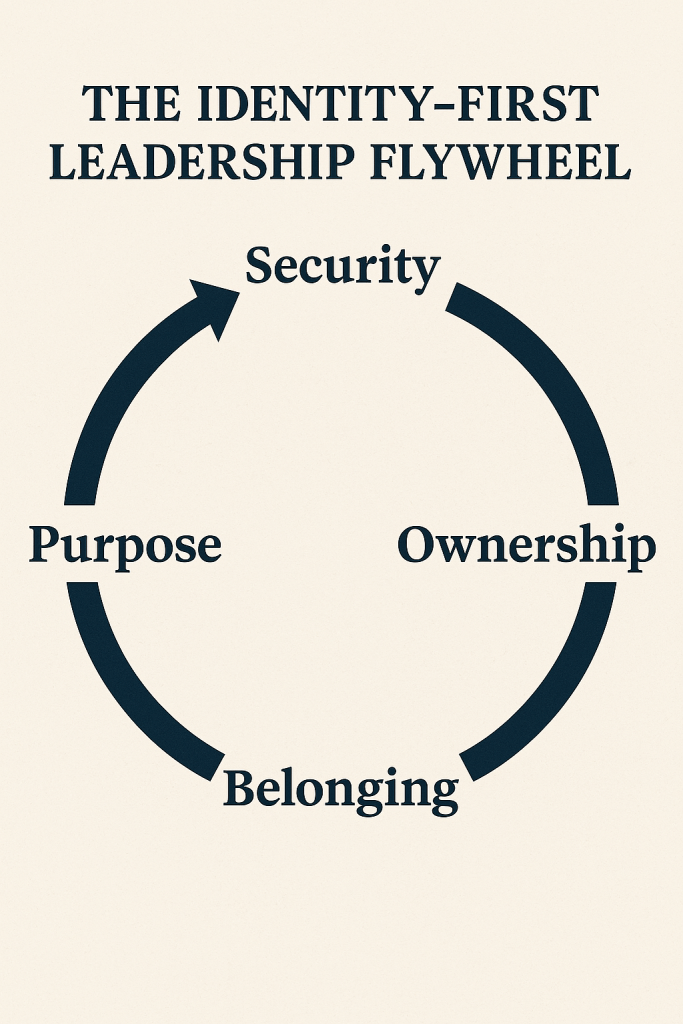
We call it the Motivation Flywheel™—a simple but powerful concept rooted in psychology, not hype. Here’s how it works:
🔹 Security
People need to feel safe—emotionally, relationally, and psychologically. This doesn’t mean avoiding hard truths or eliminating pressure. It means creating an environment where people aren’t afraid to speak, stretch, or struggle without fear of humiliation or silent judgment.
🔹 Ownership
When people help shape the process, they invest in the outcome. Ownership doesn’t mean anarchy—it means treating people like partners, not tools.
🔹 Belonging
Motivation deepens in community. Not performative team-building, but genuine shared mission. People must feel they matter to the mission and to each other.
🔹 Purpose
Finally, people need to know why it matters. Not just “what we’re doing” but “what it means.” Purpose turns repetitive tasks into meaningful contribution. It answers the inner question: Does this matter?
When these four elements spin together, they form a flywheel of self-reinforcing motivation. It’s not perfect. It requires intention. But unlike pressure-based models, it doesn’t collapse when the rewards stop or when the leader leaves the room.
A Moment When I Got It Wrong
Years ago, I led a team through a massive initiative—one that meant everything to me. The strategy was solid, the stakes were high, and the vision was compelling. I poured myself into it.
I motivated the team with urgency, clarity, and consistent recognition. We hit every milestone. From the outside, it looked like a textbook success.
But a few weeks after launch, one of my most capable teammates asked to transition off the team. She was gracious. Complimentary, even. But something in her tone felt… off. I asked what was really going on.
After a long pause, she said:
“It’s not that I didn’t care. I just didn’t feel like any of it came from me. I was executing your passion, not contributing my own.”
She wasn’t wrong. I had worked hard to ensure alignment—but I had bypassed ownership. I had communicated urgency—but not autonomy. I had motivated compliance—but I had missed the invitation to shared meaning.
It was one of the most humbling lessons of my leadership life.
What Great Leaders Do Differently
Great leaders don’t manufacture motivation.
They cultivate the conditions where it grows.
Here’s what that looks like in practice:
- They ask before they instruct. They invite team members into the problem, not just the solution.
- They coach, not control. They replace micromanagement with developmental feedback.
- They explain the “why” consistently. Not as a slogan, but as a grounding framework.
- They reward learning, not just outcomes. When people take ownership of mistakes, they’re encouraged—not shamed.
- They stay emotionally accessible. They don’t hide behind role or rank.
And perhaps most importantly: they do the inner work of leading from their own identity. Because you can’t build an intrinsically motivated culture if you’re still leading from performance pressure yourself.
A Final Word: The Culture You Build Will Shape the Person You Become
Leadership is not a neutral endeavor. It leaves a mark—on the people you lead, and on the person you become in the process. Every decision about how to motivate, how to correct, how to build engagement is also a decision about the kind of culture you are shaping. More than that, it’s a reflection of your own internal leadership posture. When you build your team around urgency, rewards, and pressure, you don’t just create external strain—you train yourself to believe that pressure is the only thing that works.
But there is another path. Leaders who commit to intrinsic cultures—who prioritize ownership over compliance, purpose over pressure—build something far more lasting. They create teams that don’t need constant oversight to produce excellent work. They cultivate environments where resilience is a byproduct of meaning, not grit alone. And they lead in a way that strengthens their own identity rather than fragmenting it.
The legacy of a leader is not found in how loudly they push, but in how deeply they shape. And the teams that endure—the ones people remember and fight to stay part of—are almost always built on something deeper than incentive. They are built on trust, on dignity, and on the kind of motivation that doesn’t need to be refueled every Monday morning.
Ready to Build a Culture That Doesn’t Burn Out?
If this resonates—if you’re tired of managing motivation through pressure and want to lead from something deeper—then let’s talk.
Identity-First Leadership Sessions are built for executive teams, founders, and people-leaders who are ready to shift from anxiety-driven urgency to identity-rooted clarity.
We teach the Motivation Flywheel™ from the ground up—applying it to real people, real teams, and real-world complexity.
Because performance-based cultures can produce results. But identity-based leadership builds something better: trust, resilience, and longevity.
We’re currently booking sessions for June.
📩 Reach out at influencejournalforleaders@gmail.com to see if it’s the right fit for your team.


Leave a Reply