Remote work isn’t what’s breaking your team—unclear leadership is. This in-depth article explores how the erosion of trust in hybrid teams leads to misalignment, disengagement, and lost momentum—and how to fix it.
The Hidden Fracture of Hybrid Work
The shift to remote and hybrid work came faster than anyone expected. In early 2020, companies scrambled to send employees home. Within weeks, bedrooms became offices, Zoom replaced the conference table, and strategy sessions took place with kids in the background and time zones stretched across continents.
And to everyone’s surprise, the world didn’t fall apart. Projects kept moving. Many teams performed better than expected. Pundits declared it the beginning of a new era—one defined by flexibility, freedom, and autonomy.
But something quieter was happening beneath the surface.
Over time, trust began to erode. Collaboration became clunky. Team cohesion weakened. High performers disengaged. Decisions started taking longer, and alignment became harder to maintain. It wasn’t immediate. It wasn’t dramatic. But it was real. And now, a few years into this new reality, the data is catching up with the experience: something is off inside hybrid teams.
The easy scapegoat has been remote work itself. But blaming location misses the point entirely.
The real problem isn’t that people aren’t in the same room.
The real problem is that most organizations never replaced the trust-building structures that in-person work used to provide.
The Trust That Used to Happen by Accident
In the traditional office environment, trust was ambient. It was built not just through shared goals, but through shared space. It lived in hallway conversations, post-meeting debriefs, lunch breaks, and the ten-minute chats that happened while waiting for everyone else to arrive. You learned who your colleagues were—not just what they did. You picked up tone, pace, nuance, rhythm.
In that environment, miscommunications could be smoothed over in real time. Emotional intelligence had context. Disagreements happened face-to-face. And even mediocre systems could function decently well, because the culture had touchpoints—human ones.
When companies moved to hybrid models, most of those touchpoints disappeared overnight. What remained were Slack threads, Zoom calls, shared documents, and asynchronous updates—efficient, yes. But also stripped of the subtle interactions that build relational capital.
Over time, the absence of those interactions didn’t just create distance. It created uncertainty. And uncertainty—left unaddressed—always becomes distrust.
Why Confusion Looks Like Apathy
Here’s what many leaders miss: confusion often masquerades as disengagement.
When teams start missing deadlines, when employees stop asking questions, when collaboration gets quiet, it’s easy to assume laziness or lack of motivation. But more often than not, the real issue is ambiguity. People aren’t sure what matters. They’re unsure of how decisions get made. They don’t know what success looks like. And when that ambiguity persists, trust begins to thin.
In hybrid environments, these signals are easier to miss. Disengagement is quieter. Skepticism hides behind politeness. People show up to the Zoom call, nod along, smile—and then do what they think they’re supposed to do. But without trust, without clarity, without shared assumptions, every action becomes a guess.
Leaders start to notice friction, missed handoffs, repeated conversations. They respond by tightening control—more meetings, more check-ins, more structure. But the more they chase performance without addressing the relational gap, the more their team pulls back.
What looks like apathy is often just people trying to survive a leadership system that doesn’t tell the truth early, clearly, or consistently enough.
What Remote Work Taught Me About Earning Trust From Across an Ocean
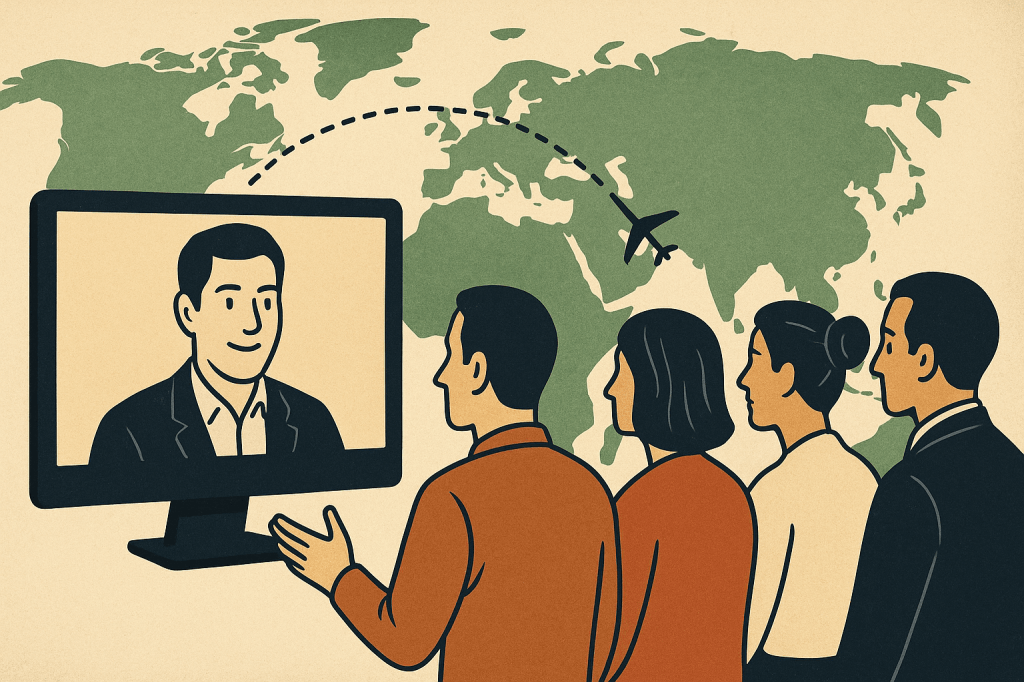
I’ve spent the previous year living overseas while continuing to do consulting work with organizations back in the U.S. From the outside, it looks efficient—Zoom strategy calls, shared whiteboards, well-timed messages. But underneath that is something far more fragile: the discipline of earning trust from across an ocean.
Remote consulting teaches you that trust can’t be assumed. It has to be built. Carefully. Intentionally. And repeatedly.
There’s no proximity buffer. No office charisma. No spontaneous bonding. If you’re unclear or inconsistent—even once—it can cost you the next six months. Clients need to know that you understand their world, that you’re invested in their success, and that your presence is not dependent on geography.
What I’ve learned is that trust is not a personality trait. It’s a system of communication and follow-through. It’s clarity of expectations. It’s showing up before you’re needed. It’s being easier to work with at a distance than most people are in person.
And here’s what leaders need to realize: this isn’t just about consulting. It’s about hybrid leadership. The same rules apply. If your team has to guess where decisions get made, if silence means uncertainty, if the loudest voice dominates because there’s no structured way to dissent—then you don’t have trust. You have performance under pressure. And that’s not sustainable.
The Psychological Cost of Distance
Human beings are wired for context. When we’re deprived of social cues, we become more anxious, more skeptical, and more likely to assume the worst. This is why remote and hybrid work—if not managed intentionally—can breed insecurity in even the most capable people.
In a high-trust environment, silence feels neutral. In a low-trust environment, it feels ominous.
When remote employees aren’t given updates, they start to assume they’re out of the loop. When feedback is vague or missing altogether, they assume they’re doing something wrong. When recognition is inconsistent, they begin to question their value. Over time, this leads to emotional fatigue. And emotionally fatigued employees don’t push boundaries. They retreat. Quietly.
The tragedy is that these people aren’t weak. They’re often your most invested, most thoughtful contributors. But the leadership environment they’re operating in isn’t built to sustain their trust over time. It was built for proximity—and that’s no longer enough.
What Trust Looks Like in a Hybrid Environment
So what does real trust look like in a hybrid system? It’s not a feeling. It’s a design. And it shows up in specific structures:
1. Purpose Over Optics
In hybrid environments, it’s tempting for both employees and managers to overcompensate—responding quickly, staying constantly “online,” or padding their schedule with visible busyness to prove engagement. But trust isn’t built through activity. It’s built through shared purpose.
Leaders must anchor their teams in mission clarity. That means clearly articulating why each role matters, how it connects to the broader story, and what outcomes flow from alignment—not pressure. The goal isn’t to create a productivity scoreboard. The goal is to remove ambiguity, so that every person knows what they’re responsible for, where they have ownership, and how their work contributes to something larger than themselves.
When people are rooted in purpose, they don’t have to prove their worth through optics. Their identity and contribution are secure.
2. Structured Communication Loops
Meetings shouldn’t be the only place clarity happens. Asynchronous tools should be used with intent—recaps, voice notes, feedback channels, decision logs. These aren’t just documentation tools. They’re trust signals.
3. Train Culture Like It’s a Skill—Because It Is
In remote environments, culture doesn’t emerge by osmosis. There’s no shared office vibe, no passive transfer of norms through observation. If leaders want a high-trust, high-alignment culture to exist in a hybrid setting, they have to teach it, not just hope for it.
That means naming the values clearly, modeling them visibly, and reinforcing them repeatedly through team rituals, onboarding, and shared language. New hires need to be explicitly taught how your team handles conflict, how feedback flows, how decisions are made, and what psychological safety actually looks like in your space.
It also means investing in the invisible dynamics—giving space for informal moments, encouraging intentional peer connection, and celebrating shared wins in ways that keep remote team members from feeling peripheral. Culture doesn’t have to be weaker in a hybrid setting. But it does have to be deliberate. The old myth that “culture is caught, not taught” falls apart when people are scattered across cities or continents. In hybrid teams, culture has to be both.
4. Psychological Safety, Built Deliberately
In hybrid teams, you can’t rely on tone or body language to communicate safety. Leaders need to go out of their way to model curiosity, invite disagreement, and affirm contributions. Silence is not neutrality—it’s data.
5. Equity in Visibility and Opportunity
Hybrid collapses when in-office staff get promoted faster, seen more often, and looped into more decisions. If your remote staff feel like afterthoughts, they’ll soon act like it.
What Companies Get Wrong When Trying to Fix This
When hybrid issues surface, companies often respond with structure alone: return-to-office mandates, meeting overload, productivity monitoring. These fixes treat symptoms, not systems.
The real issue isn’t that people aren’t together. It’s that they’re not aligned—because trust, clarity, and feedback haven’t been designed for the new reality.
You don’t need more meetings. You need better rhythms. You don’t need stricter rules. You need clearer expectations. You don’t need constant updates. You need transparent decisions.
Most importantly, you don’t need to call people back into the office to solve a leadership problem.
Leadership Is the Operating System
In hybrid work, leadership can’t be passive. The physical office used to do a lot of work for you—building rapport, creating ambient accountability, offering natural feedback loops. That system is gone. What’s left is what you choose to build.
You can build a culture where trust is structured into how you communicate, how you prioritize, how you listen, and how you decide. Or you can drift into performance theater, where everyone smiles on camera while silently pulling away.
Trust isn’t lost all at once. It’s lost in the gaps. And those gaps get wider every week a leader fails to build the systems their team now needs.
📌 Want to rebuild trust in your hybrid leadership system?
I’m building frameworks and workshops that help leaders close the trust gap, clarify what matters, and realign their teams—no matter where they work. Subscribe for updates or reach out to collaborate.
 The Influence Journal | Leadership, Trust, and the Psychology of Culture
Leave a comment