Why doing less—but doing it with weight—is the only way forward
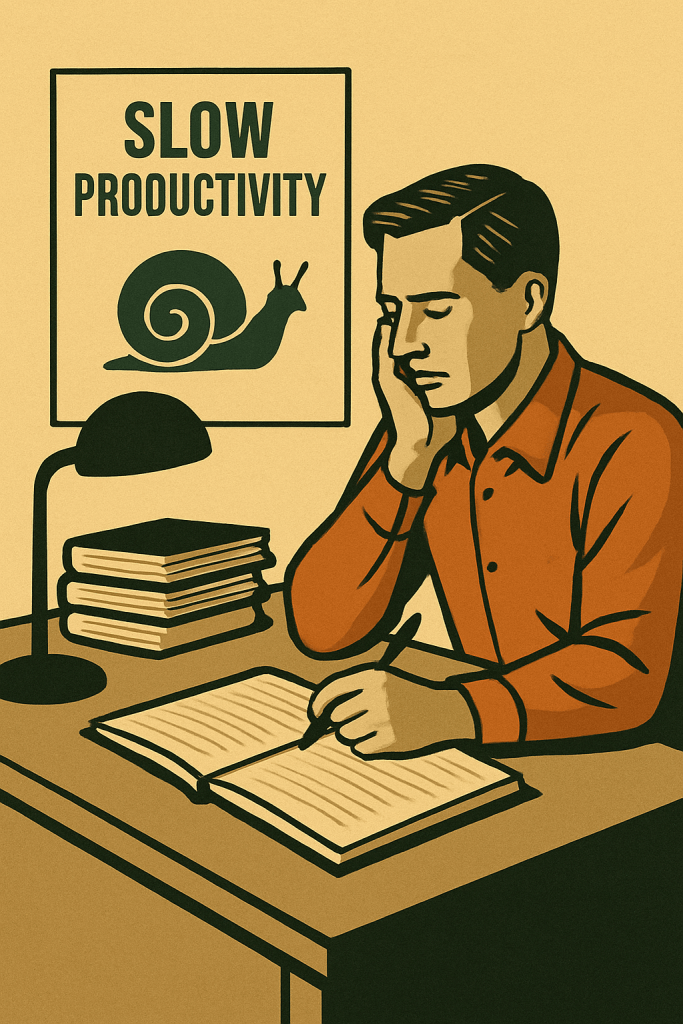
Most leaders aren’t burned out from hard work—they’re eroded by fragmented work. This essay builds on Cal Newport’s Slow Productivity to explore a better way.
There is a particular kind of exhaustion that doesn’t come from overwork. It comes from over-scattering. It is not the result of lifting something heavy, but of carrying too many light things, all at once, for too long. Most modern leaders are not crushed by one great burden. They are worn down by the impossibility of sustained fragmentation.
In his book Slow Productivity, Cal Newport articulates a simple but radically countercultural idea: our obsession with visible busyness and constant output has eroded our capacity for deep, meaningful work. We’ve come to define productivity in terms that ignore the nature of human attention, undervalue craftsmanship, and break the body and mind over time.
The goal of slow productivity, as Newport frames it, is to escape the “hyperactive hive mind”—a frenetic mode of working characterized by multitasking, shallow demands, and an always-on culture that makes deep work nearly impossible. But this is not simply a personal problem. It is a leadership crisis.
In the executive world, pace has become moralized. To move slowly is to fall behind. To protect your attention is to seem aloof. To push back on urgency is to be perceived as incompetent or obstructive. Yet every year, more and more leaders quietly admit they are producing more—and becoming less.
This is not a time-management issue. It is a question of integrity: Can you lead others if you are no longer able to hold your own mind still long enough to think clearly?
What Fast Productivity Is Doing to Leadership
At the highest levels of organizational life, most leaders are praised for their responsiveness. But fast productivity has a cost structure that cannot be sustained.
Consider what it often produces:
- Cognitive fatigue from constant context-switching.
- A loss of strategic depth.
- Delegation that becomes abdication.
- Decision-making driven by optics instead of wisdom.
- A culture that confuses motion with movement.
Newport notes that in knowledge work, output is not measured in units assembled but in quality of thought. And yet most leadership cultures push for the kind of work that resembles the assembly line: predictable, measurable, reactive. There is no time to dwell. No margin to reframe. No reward for restraint.
What disappears, slowly but with devastating regularity, is judgment.
Leaders don’t stop caring. They stop seeing. They stop thinking. And eventually, they stop leading—even if their calendar remains full.
The Argument for Fewer, Better
Newport’s version of slow productivity rests on three principles:
- Do fewer things.
- Work at a natural pace.
- Obsess over quality.
All three are in tension with modern executive expectations. To do fewer things, a leader must confront the fear that they will miss something essential. To work at a natural pace, they must endure the cultural suspicion that they are inefficient or unmotivated. To obsess over quality, they must embrace the kind of slowness that rarely impresses shareholders.
And yet, when a leader builds around these principles, something extraordinary happens: presence returns. Decisions become more anchored. Teams begin to orient around values, not just objectives. Vision becomes clearer, because it is not constantly fogged by noise.
None of this comes quickly. It is not a shift you announce. It is a way of being you begin to inhabit. Quietly. Deliberately. Over time.
Building Human-Scale Rhythms in an Industrial-Scale System
Most organizations are not designed for human-scale work. They are designed for extraction—of value, of labor, of attention. A leader committed to slow productivity must work against the system while remaining inside it.
This requires more than personal discipline. It requires moral imagination.
A leader must learn to:
- Protect deep work as a leadership priority.
- Redesign meetings as generative, not performative, spaces.
- Set expectations that reward long-term thinking.
- Refuse to glorify exhaustion.
- Model the kind of internal clarity they hope to see replicated.
It also requires being misunderstood. Perhaps even penalized. Because the early fruits of slow productivity are invisible. The room gets quieter. The email slows down. The insights come later. But when they arrive, they land heavier.
Over time, what emerges is not just a new calendar. It is a different kind of presence. The kind that carries weight in silence. The kind that reshapes the atmosphere of a room.
Recovering the Space to Think
Newport’s work reminds us that the most powerful work a leader does often happens below the surface. It cannot be tracked on a dashboard. It does not generate a ping or a post. It is the mental clarity that allows you to say no. It is the refusal to react. It is the quiet confidence that waits when others are scrambling.
Slow productivity is not a rejection of ambition. It is a refusal to serve chaos. It is an act of leadership to think clearly, to choose wisely, to do work that endures.
Because in the end, leadership is not about how fast you deliver. It is about whether what you deliver matters at all.
When You’re Ready to Work Differently
You don’t need another app. You need a new mindset. One that resists the industrial expectations placed on your soul.
Subscribe to The Influence Journal for essays that take your leadership seriously—because slowing down is not weakness. It’s the first act of authority.
 The Influence Journal | Leadership, Trust, and the Psychology of Culture
Leave a comment