

Identity-First Leadership is a new leadership model rooted in internal clarity—not external performance. Discover the framework that prioritizes identity, trust, and motivation to build sustainable influence.
Leadership has, for too long, been a discipline of external focus. We define effective leadership by output, efficiency, and perception. Metrics are the gold standard. Visibility is proof of value. Success is proof of competence. In nearly every domain—corporate, nonprofit, academic, even personal development—leadership has become a performance sport. And in many ways, it has worked. We have created systems that reward the driven, promote the productive, and amplify those with the clearest, most curated signals of achievement.
But underneath this high-output machinery lies a quieter crisis: the erosion of identity within the leader. As the metrics grow more sophisticated and the expectations more relentless, the inner life of the leader grows more fragile, more anxious, and more reactive. When leadership becomes something we perform rather than something we embody, it loses both its center and its sustainability. In short, the performance based models create a mental health crisis.
This is the premise that grounds Identity-First Leadership. It is not a rejection of performance, but a reordering of it. It begins not with what a leader produces, but with who a leader is. It treats internal coherence as a strategic priority, not a soft ideal. It does not idolize authenticity nor overcorrect into self-centeredness. Instead, it creates a structured framework for sustainable influence—one in which the leader’s core identity drives decisions, shapes culture, and multiplies trust.
This is not a philosophy. It is a system.
What Is Identity-First Leadership?
Identity-First Leadership is the discipline of anchoring leadership in internal clarity, so that trust, motivation, and long-term influence flow naturally. It is based on the belief that leadership cannot sustainably scale from pressure, perfectionism, or performance metrics alone. Instead, the most enduring and transformational leaders operate from a deeply integrated sense of identity—one that informs how they engage others, how they handle stress, how they make decisions, and how they recover from failure.
In contrast to personality-driven leadership or authenticity-based rhetoric, Identity-First Leadership is neither improvisational nor self-indulgent. It is not “just be yourself” with a corporate face. It is structured. Repeatable. Trainable. And it is grounded in research from psychology, organizational health, and behavioral economics—all of which increasingly affirm the importance of internal security in producing lasting influence.
Identity-First Leadership asserts that the root of effective leadership lies not in outputs, but in the internal condition of the person doing the leading. When that condition is coherent, integrated, and aligned, the outer expressions of leadership—strategy, culture, execution—become not only more consistent, but more trustworthy. Conversely, when the internal condition is dislocated, the leader becomes increasingly dependent on control, incentives, and emotional detachment to preserve power.
The Three Pillars of Identity-First Leadership
At the heart of the Identity-First model are three essential anchors. These are not mere values—they are structural reorientations that shift how leadership is practiced at every level:
1. Identity Over Performance
In performance-based models, leaders derive legitimacy from outcomes. You are effective because the metrics say you are. While this can yield impressive results in the short term, it produces two dangerous byproducts: comparison and insecurity. The leader becomes addicted to affirmation and allergic to failure. Identity-First Leadership reverses the dynamic. You do not lead because you produce. You produce because you are anchored.
This does not mean that results don’t matter. It means that results are not the source of self-definition. Leaders grounded in identity are not less ambitious—they are less fragile. They can absorb critique without collapsing. They can face market losses without scrambling to prove themselves. And they can resist the temptations of ego when the spotlight grows hot.
2. Trust Over Control
Research across organizational psychology confirms what experience already tells us: high-control environments erode psychological safety, reduce innovation, and increase disengagement. Identity-First leaders create cultures where trust is not a reward for performance, but a default posture toward others. They lead not by force, but by clarity. They don’t need to micromanage, because they have built systems and relationships that operate on shared values.
This emphasis on trust is not naive. It is strategic. According to Paul Zak’s neuroscience-based studies on trust in the workplace, employees in high-trust organizations report 74% less stress, 50% higher productivity, and 76% more engagement. But more than that, trust creates resilience. When the organization is under pressure, identity-first leaders don’t pivot to coercion—they pivot to deeper communication and stronger alignment. This produces long-term loyalty that outperforms artificial incentives or short-term perks.
3. Intrinsic Motivation Over External Pressure
One of the most powerful insights in motivation science comes from Deci and Ryan’s Self-Determination Theory, which identifies autonomy, competence, and relatedness as core drivers of intrinsic motivation. Performance-based leadership frequently ignores these drivers in favor of what’s quantifiable: deadlines, bonuses, KPIs, and compliance. Identity-First Leadership re-centers motivation in purpose. People are not motivated merely by what they get for doing the work—they are motivated by why the work matters and how it aligns with their values.
This doesn’t mean external metrics disappear. It means that metrics are subordinated to meaning. Identity-First leaders help their teams locate their contribution inside a broader narrative—one that honors agency and fosters ownership. The result is not just higher engagement, but more sustainable effort. Motivation becomes self-renewing because it is no longer tied to constant pressure or fear of failure.
Visual Frameworks: Anchoring the Model
To crystallize the model, Identity-First Leadership can be visualized in two primary ways:
The Identity Triangle
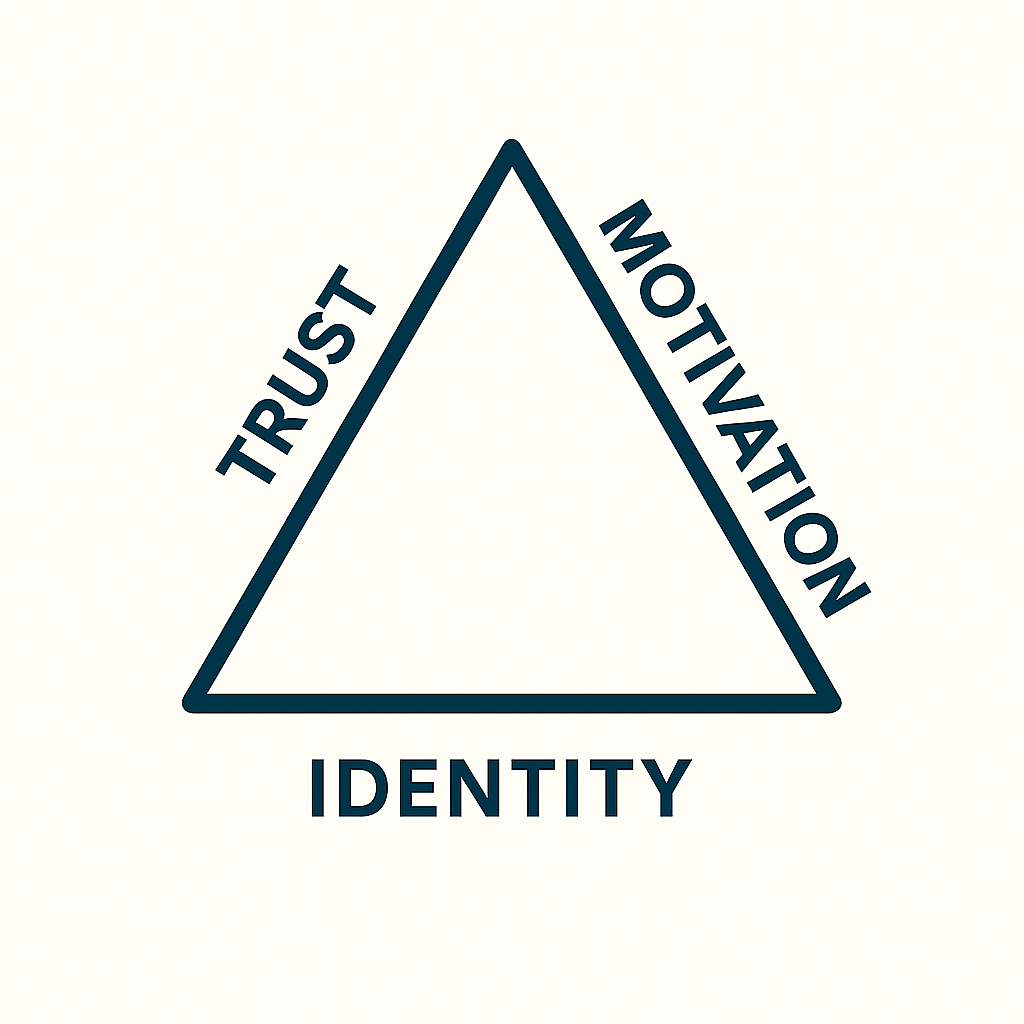
In this model, Identity forms the base—stabilizing the leader internally. From this foundation, Trust (relational security) and Motivation (directional energy) emerge. Performance, while not depicted, is treated as a byproduct of these core conditions, not a pillar of the framework itself.
The Identity Flywheel
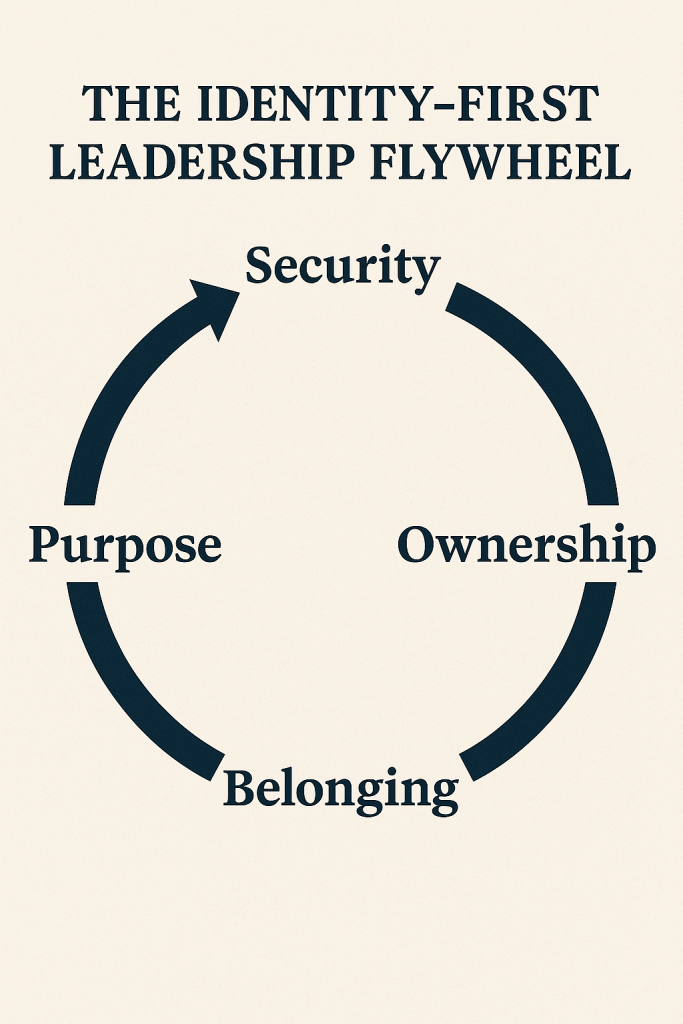
This variation shows the dynamic, cyclical nature of identity-first influence:
Identity → Trust → Motivation → Clarity → Momentum → Return to Identity (Reinforced)
As leaders operate from identity, they build trust. That trust energizes intrinsic motivation. Motivation creates movement with clarity. And as momentum builds, the leader’s sense of calling is reaffirmed, feeding back into identity. This is not static leadership. It is compounding.
How It Functions in Practice
To illustrate how Identity-First Leadership operates on the ground, consider the following contrasts:
| Scenario | Performance-First Leader | Identity-First Leader |
|---|---|---|
| Crisis or failure | Doubles down on control, hides weakness | Names the loss, anchors in values |
| Team underperforming | Uses pressure, imposes new KPIs | Seeks ownership, renews shared purpose |
| Personal burnout | Pushes through to “prove” resilience | Steps back to realign and recover |
| Recognition and success | Internalizes as identity (“I am my success”) | Receives success without anchoring identity to it |
| Conflict on the team | Avoids or delegates | Leans in to model trust and clarity |
This isn’t about being “better” in a moral sense. It’s about building a model of leadership that scales healthily. Identity-first leaders replicate trust, which creates aligned teams, which then carry the mission forward with far less friction or dependency.
What Identity-First Leadership Is Not
To define something clearly, we must also distinguish it from what it is not. Identity-First Leadership:
- Is not performative vulnerability. It does not reward emotional exhibitionism or confuse self-disclosure with maturity.
- Is not soft leadership. It retains the sharp edge of accountability, but sharpens it with clarity rather than pressure.
- Is not reactive to hustle culture. It does not posture as an “anti-leadership” trend, but reorders the system with a more enduring logic.
- Is not static or self-absorbed. It is not about naval-gazing or endlessly reflecting on personality—it is about aligned action.
Final Definition
Identity-First Leadership is the structured practice of leading from internal security rather than external validation. It is grounded in identity, fueled by trust, and multiplied through intrinsic motivation. It does not replace performance. It reframes performance as the fruit, not the root, of sustainable influence.
Moving Forward
This article introduces the foundational definition of Identity-First Leadership. If you’re interested in hearing more, let’s schedule a call and see if our training could be a good fit for your team. We’re currently scheduling training courses for the fall. Reach out here:
influencejournalforleaders@gmail.com
In a time when burnout is normalized, trust is collapsing, and leadership is increasingly transactional, the need for Identity-First Leadership has never been more urgent. But urgency alone isn’t enough.
We need a new framework. This is the first step.
 The Influence Journal | Leadership, Trust, and the Psychology of Culture
Leave a comment