
A mini-training on how to lead without performing.

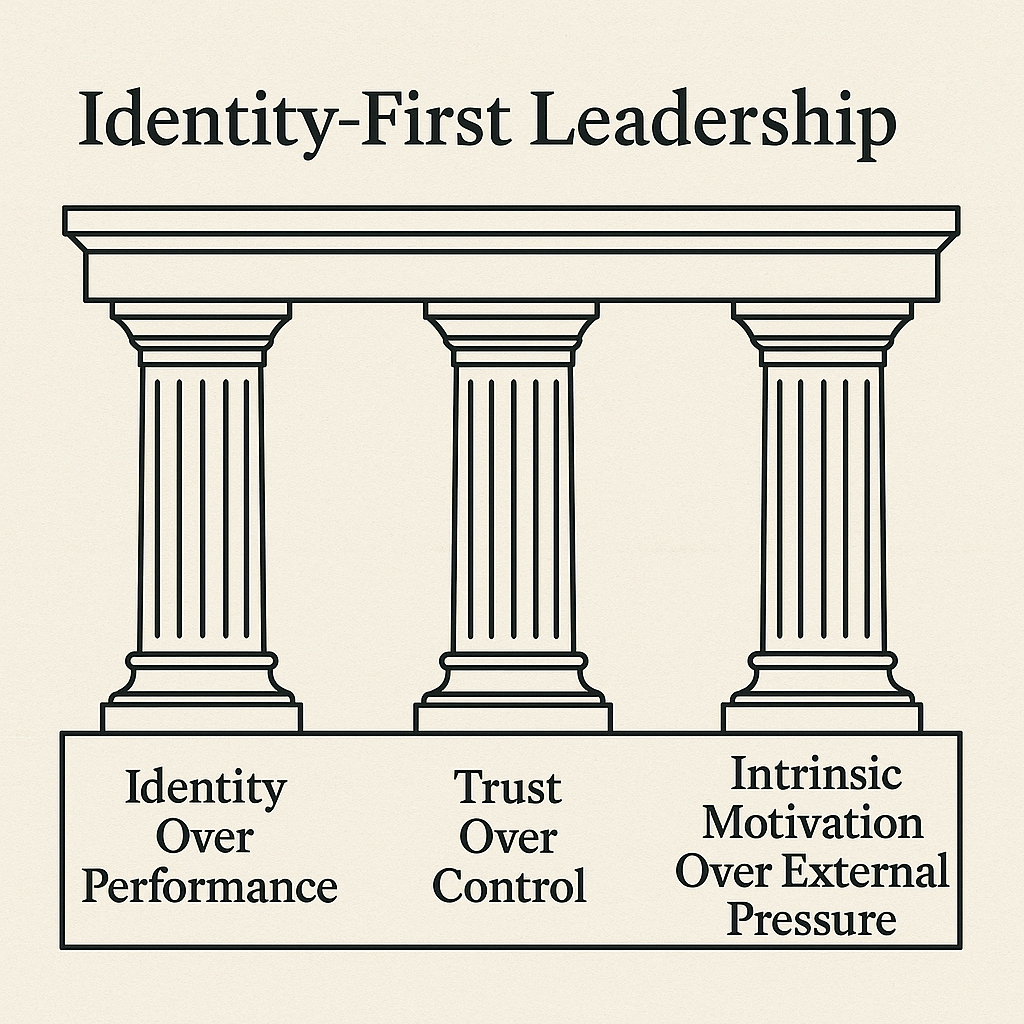
This is the first of three articles introducing Identity-First Leadership™, a leadership model that prioritizes internal anchoring over external performance. Learn how to identify performance traps, audit your leadership identity, and build trust from the inside out with a practical, research-backed mini-training.
There’s a quiet kind of exhaustion that most leaders carry but never identify. It’s not the fatigue of long hours or the pressure of complex decisions. It’s the burden of maintaining an image—of being seen as competent, composed, visionary, and indispensable, even when your internal world is fraying at the seams. This unspoken performance obligation slowly drains energy, blurs self-awareness, and eventually distorts decision-making. And yet, the performance remains, because the cost of being seen as unsure or unfinished feels higher than the cost of pretending.
This is the first of a three-part series on Identity-First Leadership™, a framework designed to challenge the hidden insecurities beneath modern management. If you’ve ever felt like leadership is more about optics than integrity—more about curating an image than developing a center—you’re not imagining things. Today’s leadership culture rewards polish, precision, and productivity. But the leaders we trust most are not the ones performing those things. They’re the ones anchored in something deeper. This series will give you three mini-trainings to help you rebuild from the inside out—starting with the most countercultural idea of all: you don’t have to prove yourself to lead well.
If you find yourself resonating with what follows and want to explore how Identity-First Leadership can shape your team or culture, reach out. This is more than a framework—it’s a training model, and it’s available to organizations ready for something deeper.
The Hidden Cost of Performance-Based Leadership
Performance, in itself, isn’t the problem. Leaders should be competent. They should strive to grow, to deliver, to execute. But something shifts when performance becomes the basis of identity rather than the fruit of it. In most executive cultures, the line between “I perform” and “I am my performance” is blurred beyond recognition. The moment you internalize that your value as a leader is proportional to your output, you enter a leadership mode driven by insecurity. You begin to fear quiet seasons, slow feedback loops, or team conflict—not because they’re inherently problematic, but because they threaten your sense of self.
That fear quietly reshapes your leadership. It makes you avoid truth-telling conversations. It makes you overpromise. It makes you addicted to visibility and allergic to delegation. Eventually, it makes you fragile. And here’s the tragedy: the very performance you’re trying to protect becomes the reason your leadership loses depth. The people around you begin to sense that something is off. You’re quick to correct but slow to listen. You defend your ideas with polished arguments but don’t invite others into them. You hold the room, but you no longer hold their trust. It’s not because you lack charisma or competence. It’s because your center is hollow. You’re leading from performance, not identity.
Why Identity Matters More Than You Think
In the Identity-First Leadership model, everything begins with a single premise: your leadership will always flow from your core, not your craft. That means your strategies, your style, your strengths—all of it—is downstream from who you believe yourself to be. And if your core is built on proving rather than anchoring, you will inevitably bend your leadership toward image management. That might work for a while. But over time, the cracks start to show. High performers burn out. Culture erodes. Trust collapses under the weight of unchecked ego or disguised anxiety.
Leading from identity doesn’t mean rejecting performance. It means rooting it. The most trusted leaders aren’t trying to impress. They’re not afraid of being wrong. They’re not overly concerned with being the smartest in the room. Instead, they operate from a quiet clarity: they know who they are, why they’re here, and what they won’t compromise—even if it costs them recognition. That kind of clarity doesn’t come from a quarterly review. It comes from doing the hard inner work of disentangling worth from output. That’s what this post is for.
Mini-Training: The Leadership Identity Audit
Here’s your first step: conduct a Leadership Identity Audit. Block 30 minutes. No email. Shut the computer. Put down the phone. This isn’t a personality test or values worksheet. It’s a recalibration. Below are three deceptively simple questions. They’re designed to expose what’s driving you and where your identity may be compromised by performance.
1. What do I fear people will discover about me as a leader?
This question is brutal—but it’s the fastest way to name the hidden scripts underneath your actions. Do you fear being seen as in over your head? As too soft? Too young? Too inflexible? Your fear will always try to write your leadership playbook unless you call it out and rewrite it from a secure foundation.
2. What am I doing that is more about perception than effectiveness?
There are things you do every week—meetings you lead, emails you send, decisions you explain—not because they’re needed, but because they make you look organized, decisive, or in control. That isn’t always bad. But over time, perception-based leadership becomes exhausting, and worse, it makes you untrustworthy. People can sense when a leader is acting instead of leading.
3. Where do I feel most grounded in my role—and what makes that different?
Some parts of your leadership feel settled. Others feel shaky. That contrast matters. Find the patterns. Is your confidence tied to technical mastery? To team chemistry? To feeling respected? Often, what grounds us reveals what we’re leaning on. The goal isn’t to eliminate these things. It’s to ensure your foundation doesn’t shift with them.
The Practice: Anchoring Daily
Once you’ve done the audit, don’t stop there. Identity-based leadership must be cultivated. Every morning, ask yourself one anchoring question:
“What do I want my team to feel because of how I lead today?”
Not what you want them to think of you. Not what you want them to achieve. What do you want them to feel—clarity, safety, trust, energy? Your answer will surface your leadership posture. And over time, asking this question will start to reshape it.
You’re not leading to prove your worth. You’re leading to create an environment where others can bring theirs.
Leadership That Doesn’t Flinch
If you want to build a leadership culture that doesn’t collapse under pressure, you have to start here. Not with tactics. Not with KPIs. But with identity. Everything else—vision, strategy, systems—comes after. This isn’t soft introspection. It’s infrastructure. Performance can impress people. Identity builds movements.
This is the first installment in our Identity-First Leadership™ training series. If you’re interested in bringing this model into your organization or team, reach out for coaching or workshop opportunities.
You can also subscribe to The Influence Journal to get the next two trainings:
- Trust Over Control – a mini-drill in releasing fear-based management
- Intrinsic Motivation Over External Pressure – a tool for long-term engagement without burnout
Leadership is not an act. It’s an overflow. Let’s start leading like it.
 The Influence Journal | Leadership, Trust, and the Psychology of Culture
Leave a comment