Identity-First Leadership™, Session Three

Most teams aren’t underperforming—they’re exhausted from pressure-based leadership. This is the third in a series of mini-trainings on Identity-First Leadership™. This article introduces the Motivation Flywheel™ and shows how identity-first leaders build sustainable drive through security, ownership, belonging, and purpose.
The Failure of Pressure-Based Motivation
Most organizations aren’t actually powered by energy. They’re powered by pressure. Not the kind that produces excellence, but the kind that slowly wears people down while pretending to drive them forward. You see it in teams that hit their numbers but stop innovating. You see it in high-performing individuals who suddenly burn out. You see it in environments where everything looks efficient, but nothing feels alive.
This kind of motivation works—until it doesn’t. It gets compliance, but not conviction. It produces output, but not ownership. And when a team’s internal drive collapses, no amount of incentives, perks, or performance feedback will revive it. You can’t pressure people into purpose. And you can’t manufacture energy through expectation alone.
The cracks don’t appear all at once. They begin subtly—in the way your highest performers start to disengage from meetings, in the reduced creativity on formerly energized projects, in the increasing sense that people are protecting themselves instead of taking risks. What looks like a capacity problem is often a motivation problem in disguise. And once it takes root, the slow leak is hard to reverse.
That’s why Identity-First Leadership™ doesn’t begin with outcomes. It begins with the internal posture of the leader and the motivational ecosystem they create. Because people don’t do their best work when they’re pushed. They do their best work when they’re anchored—in purpose, in clarity, and in trust.
How External Motivation Erodes Ownership
Pressure-based leadership often masquerades as urgency. Leaders raise the stakes. They talk about what’s on the line. They escalate accountability. But instead of igniting purpose, they slowly rewire the team’s relationship to the work. Initiative becomes obligation. Risk-taking becomes risk avoidance. And over time, the work becomes about managing perception rather than contributing meaningfully.
People still show up. They still perform. But the emotional contract changes. Instead of thinking, “This matters and I want to own it,” the team starts thinking, “I need to get this right so I don’t fall behind.” And that shift—from purpose to pressure—always leads to disengagement. Because you can’t sustain energy when your work is built on fear.
The signs are often subtle: the best ideas stop getting voiced. Tasks are completed with competence but without creativity. People ask more questions about deadlines than about vision. The room gets quieter. The pace remains, but the soul starts to disappear.
What begins as hustle becomes hollow. And when leaders respond by doubling down—increasing reviews, tightening processes, calling for more focus—they often accelerate the drift they’re trying to fix. Because pressure does not produce loyalty. It only suppresses dissent.
High-functioning teams don’t grow from high-pressure environments. They grow from high-trust environments where people feel safe enough to risk themselves in the work. The moment your team starts managing your expectations instead of pursuing a shared purpose, the motivation is no longer sustainable. It has become a transaction.
The Motivation Flywheel™: A New Center of Gravity
At the core of Identity-First Leadership™ is a different approach to motivation. Not reactive. Not fear-based. But deeply human and quietly powerful. It’s called the Motivation Flywheel™, and it revolves around four interconnected forces: Security, Ownership, Belonging, and Purpose.
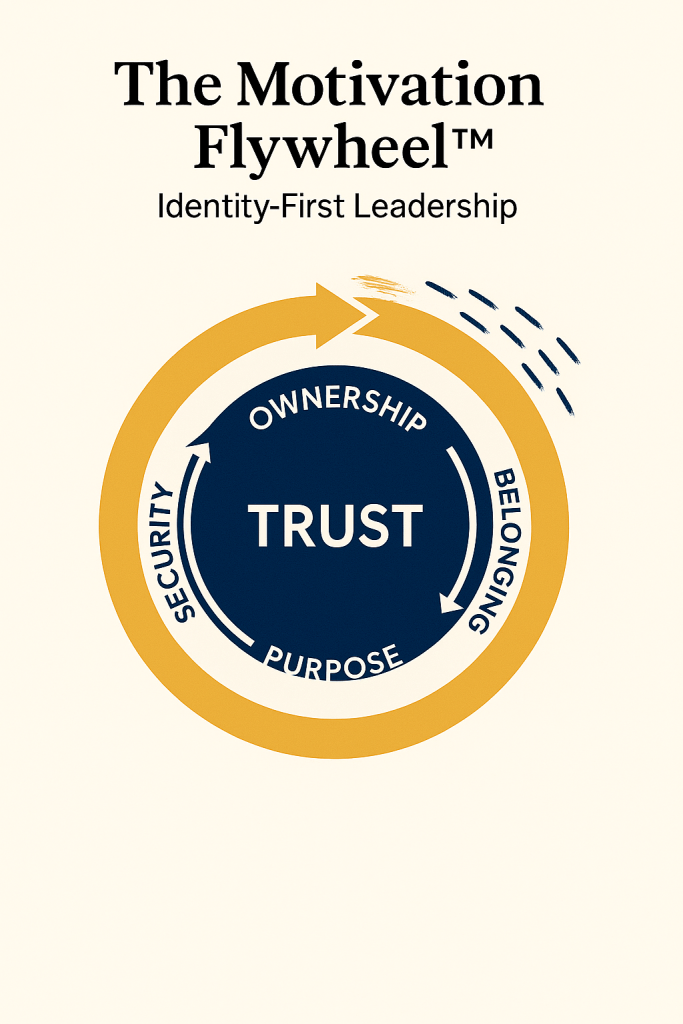
Security means that people feel safe enough to take risks. Not just job security, but relational safety—the knowledge that failure doesn’t equal rejection, and challenge doesn’t lead to punishment. Security is not a nice-to-have. It is the baseline condition for trust, creativity, and sustainable contribution. When people feel secure, they’re more honest. More engaged. And more likely to invest themselves fully in their work.
Ownership is more than autonomy. It’s the sense that the work genuinely belongs to you. That you’re trusted to shape it, influence it, and even challenge how it’s done. It doesn’t mean isolation. It means the leader isn’t acting as a backstop to catch every imperfection—because that posture destroys initiative. When people feel true ownership, they operate differently. They anticipate needs. They care about the result. They stop waiting to be told and start moving on what matters.
Belonging speaks to the emotional reality of the team. Not just being included, but being seen and valued without having to perform your worth. In high-trust cultures, people don’t waste energy managing optics. They put that energy into the work. Belonging isn’t about superficial camaraderie. It’s about being able to show up without pretense. And in most organizations, the absence of this kind of belonging is the silent drain behind every productivity struggle.
Purpose is the gravitational pull. It’s the sense that what we’re doing matters beyond deliverables. That it has weight. That the work has meaning, not just function. Purpose isn’t about mission statements. It’s about constantly reconnecting the task to the stakes. When people are reminded of what their work serves, they begin to see their role as something larger than themselves. That shift is where real, self-renewing energy starts to take root.
When these four forces are present and interdependent, the result is internal momentum. And when internal momentum is established, the culture can sustain itself without the constant pressure of the leader’s presence. That’s the essence of the flywheel: once it’s turning, it carries weight that doesn’t have to be pushed.
Why It Must Begin with the Leader’s Identity
You can’t build a Motivation Flywheel™ if you’re leading from insecurity. Because pressure leaks. If you’re driven by the need to prove yourself, the people you lead will feel that pressure in every task. If you’re unsettled, they’ll sense it. And they’ll begin responding not to the work, but to your internal anxiety about the work.
That’s why the first step isn’t structural. It’s personal. Leaders have to shift from performing leadership to inhabiting it. That shift—from performance to identity—isn’t abstract. It changes how you speak. How you delegate. How you handle tension. How you respond when the work isn’t going well.
Leaders who lead from identity don’t default to control when things get hard. They don’t weaponize urgency to mask their fear. They cultivate clarity instead of panic. They know that their presence either amplifies pressure or releases it. And they choose to build the kind of presence that restores.
This is not theory. It’s practice. And it’s visible in the day-to-day. In how you run meetings. In how you respond to delay. In whether your team feels empowered or evaluated. Whether they feel seen or scanned.
When a leader is rooted, the team breathes easier. And when the team breathes, the energy returns. Not instantly. But steadily. And the result isn’t hype. It’s drive.
To bring the full Identity-First Leadership™ Workshop to your team or executive cohort, reach out directly. These trainings are designed not just to teach concepts, but to shift posture—so the change actually sticks.
Motivation doesn’t begin with pressure. It begins with presence.
Let’s build something worth sustaining.
 The Influence Journal | Leadership, Trust, and the Psychology of Culture
Leave a comment