
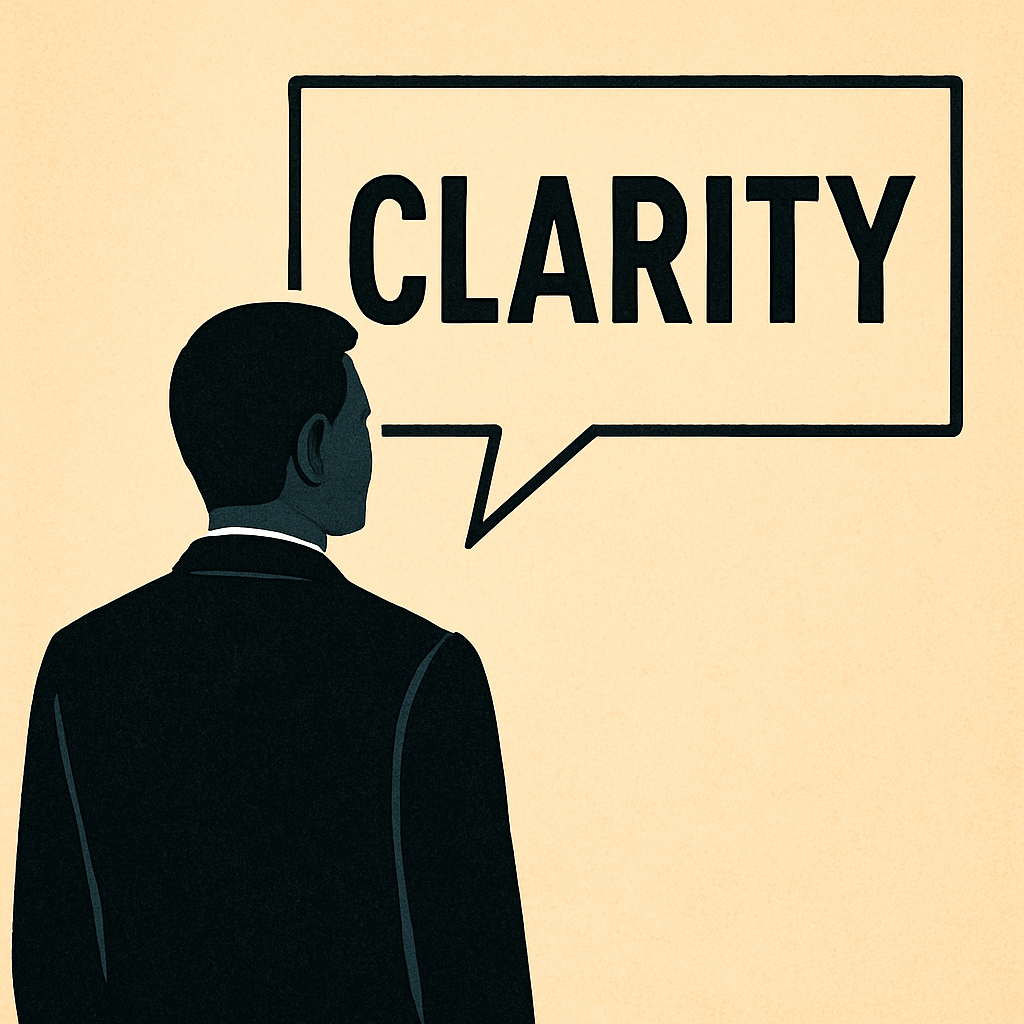
Confused teams don’t need more motivation—they need clarity. This article explores how relentless clarity in leadership boosts trust, execution, and team alignment, with lessons from psychology, strategy, and firsthand experience.
Organizations rarely crumble all at once. They drift—quietly, imperceptibly. Friction builds slowly. A missed deadline here, a derailed project there. The staff meeting ends in vague agreement, but no one really knows what happens next. Weeks pass, then months. Eventually, performance dips, engagement flags, and key contributors move on. Leadership begins searching for explanations: maybe it’s a lack of strategy, maybe it’s resistance to change, maybe it’s just burnout.
But more often than not, the root issue isn’t laziness or incompetence. It’s confusion. Most teams don’t fail because they don’t care. They fail because they’re not clear on what they’re supposed to care about. In the absence of clarity, even the most competent teams will hesitate. Energy gets wasted on guessing, second-guessing, or navigating unspoken expectations. Momentum stalls. Trust thins. Eventually, the cost isn’t just strategic—it’s cultural.
Clarity Is Not the Opposite of Complexity—It’s the Antidote
In their book Made to Stick, Chip and Dan Heath explore why certain ideas endure while others disappear. One of their key insights is that people remember ideas that are simple—not simplistic, but boiled down to their core truth. Simplicity, in this sense, is not about minimizing complexity, but about surfacing the most essential, most memorable insight and communicating it in a way that cuts through noise.
The same principle applies to leadership. Effective leaders do not ignore complexity, but they refuse to let it paralyze communication. They understand that every level of their organization—executive, managerial, and operational—functions better when the mission is unmistakable, when priorities are ranked, and when decisions are framed by a common mental model. In times of uncertainty, people don’t need ten strategic objectives. They need one clear north star. And they need to hear it more than once.
Why Clarity Feels Like Overkill (But Isn’t)
Many leaders fear repeating themselves. They assume that clarity was achieved the moment the words left their mouth. They interpret glazed expressions as comprehension. They’re reluctant to revisit decisions or re-explain rationale because they don’t want to insult the intelligence of their teams. But this is the myth of the overcommunicator—and it’s one of the most costly illusions in leadership.
The truth is that clarity isn’t achieved through a single explanation. It’s achieved through consistent, concrete, repetitive framing over time. In Made to Stick, the Heath brothers note that concreteness—the ability to turn abstract concepts into tangible language—is what makes an idea sticky. In leadership, it’s what makes a vision livable. A compelling idea that’s too abstract to guide action will die. A well-intentioned strategy without clarity will stall. Communication isn’t complete when it’s spoken—it’s complete when it’s understood, remembered, and acted on.
How We Built a Culture Around a Single Sentence
Years ago, before launching a new nonprofit, I spent six months crafting what would become a 17-word mission statement. It wasn’t accidental or aspirational. It was excruciating. Every word had to earn its place. Alongside it, we developed a 15-word vision statement—something clear enough to be remembered, short enough to be repeated, and strong enough to endure.
Those statements weren’t posters on a wall. They became our vernacular. Our leadership team used them daily, sometimes without even realizing it, and over time they embedded themselves into the DNA of the organization. They flowed from three simple but powerful points of vision that had shaped our founding conversations. And more than anything else, they were embodied by a team that deeply believed in them.
We didn’t just communicate them—we built around them. And that clarity of vision became our most common external compliment. People may have disagreed with us or challenged our decisions, but no one ever wondered what we were about. That clarity made everything else easier—hiring, decision-making, launching new initiatives, knowing when to say no. We never had to stop and “redefine our values” midstream. Because we’d already done the hard work of defining them upfront.
Clarity doesn’t just save time. It saves trust. And when it’s designed into the bones of a culture, it becomes a force multiplier that protects momentum even in seasons of transition or uncertainty.
Clarity Must Be Designed Into the Operating System
Leaders often treat clarity like a communication skill—something to be turned on in a speech or during a strategic reset. But clarity must be embedded in the operating system of the organization itself. That means clear expectations, not just job descriptions. It means team rhythms that clarify—not just report. It means decision-making frameworks that reveal trade-offs, not just assign blame.
In high-trust cultures, clarity is not a luxury. It’s a safeguard. It protects morale, reinforces direction, and keeps momentum from splintering under pressure. And it needs to be ruthless. If a meeting isn’t clear, it shouldn’t happen. If an initiative can’t be stated in a single sentence, it’s not ready to launch. If a team can’t articulate the “why” behind what they’re doing, they’re likely working from assumption, not alignment.
The Leaders Who Win Aren’t Louder—They’re Clearer
Clarity is one of the most underrated leadership disciplines because it doesn’t show up on a P&L. But over time, it’s one of the biggest differentiators between organizations that thrive and those that drift. Confusion is expensive. It drains resources, saps energy, and causes high performers to disengage long before they ever quit.
Leaders don’t need to be charismatic to inspire. But they do need to be clear—relentlessly so. Clear on what matters. Clear on what’s changing. Clear on what success looks like and how we’ll know when we’ve arrived. When clarity leads, trust grows. And when trust grows, execution follows.
📌 Want help creating a clarity-first communication rhythm inside your leadership team?
I’m building tools and resources to help leaders cut through noise and lead with alignment. Subscribe for updates or reach out to collaborate.


Leave a reply to Leaders Are Story Shapers: How Culture Is Formed by What You Choose to Remember – The Influence Journal | Leadership, Trust, and the Psychology of Culture Cancel reply